

You know that sinking feeling when you check your Google rankings and everything looks fine, but your traffic is still tanking?
Yeah, I’ve been there too here’s the thing while we’ve all been obsessing over blue links and traditional SERPs, AI search engines have quietly been reshaping how people find information.
ChatGPT, Gemini and Perplexity these aren’t just fun toys anymore they’re becoming the new gatekeepers of digital visibility.
And if your brand isn’t showing up in their answers? You’re basically invisible to a growing chunk of your audience.
That’s where Mangools AI Search Watcher enters the chat.
I’ve spent the last few weeks testing this tool, and I’m going to walk you through everything what it does, who it’s actually for, and whether it’s worth adding to your SEO stack.
Spoiler alert: if you’re still treating AI search like a passing trend, you might want to rethink that strategy.
Table of Contents
What Exactly Is Mangools AI Search Watcher?
Let me break this down without the marketing fluff.
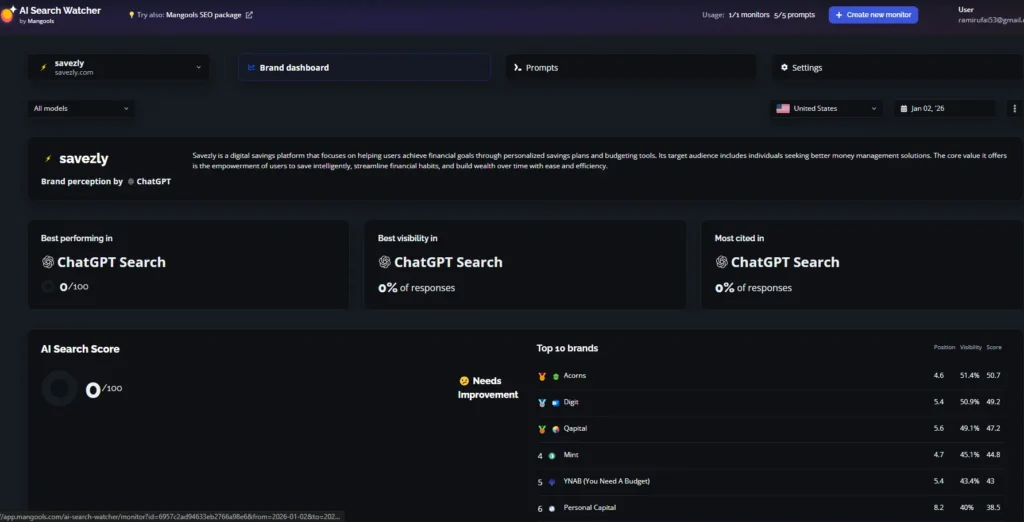
Mangools AI Search Watcher is essentially a rank tracker for the AI era instead of monitoring where you rank on Google page one, it tracks how often your brand appears in AI-generated answers across platforms like ChatGPT, Gemini, and other LLM-powered search engines.
Think of it this way: when someone asks ChatGPT, What are the best project management tools for small teams? or queries Gemini about affordable SEO software, AI Search Watcher shows you if your brand is mentioned, where it appears in the response, and how visible you are compared to competitors.It plugs into the same Mangools ecosystem you might already know SERPWatcher, KWFinder, LinkMiner but it’s focused entirely on this new frontier of AI-driven search visibility.
How Does It Actually Work?
The mechanics are surprisingly straightforward. You feed the tool specific prompts or questions (the AI equivalent of keywords).
The system then queries multiple AI search engines with those prompts and analyzes the results.
You get metrics like:
- Average position in AI responses
- Visibility scores (how prominent your mentions are)
- Citation frequency (how often you’re actually linked or credited)
- Prompt performance across different AI platforms
It’s monitoring your brand reputation in real-time across the AI search landscape.
No more guessing whether ChatGPT is recommending you or burying you six paragraphs deep where nobody scrolls.
Who Should Actually Care About This Tool?
Here’s where it gets interesting, AI Search Watcher isn’t for everyone, and that’s perfectly fine.
But if you fall into one of these camps, you should be paying attention.
SEO Professionals & Digital Marketers
You’re already tracking rankings, monitoring backlinks, and optimizing for featured snippets. But your clients are starting to ask uncomfortable questions.
Why is our traffic down even though our rankings are stable?
Traditional rank trackers don’t show how brands appear in AI answers, that’s a blind spot you can’t afford anymore.
If you’re actively exploring Generative Engine Optimization (GEO) or trying to stay ahead of the curve, AI Search Watcher gives you actual data instead of guesswork.
You can show clients exactly where they stand in this new ecosystem.
Content Creators & Bloggers
Let’s be real if you rely on organic traffic, the rise of AI search is either your biggest opportunity or your worst nightmare probably both.
The painful truth?
AI models are training on content, but they don’t always credit the original source.
You might have written the definitive guide on something, but when someone asks ChatGPT about it, your site never gets mentioned.
AI Search Watcher helps you understand whether AI search engines are referencing your content and how you’re positioned against competitors.
It’s early-warning radar for visibility shifts.
Traditional Google Rankings vs AI Search Visibility (Same Brand)
| Aspect | Traditional Google Rankings | AI Search Visibility |
|---|---|---|
| Where users see the brand | Google SERPs (blue links, featured snippets) | AI-generated answers (ChatGPT, Gemini, Claude, Copilot, etc.) |
| Ranking format | Position-based (1–10, page 1/page 2) | Mention-based (included, excluded, or recommended) |
| Traffic measurement | Clicks to website | Often no click, brand exposure only |
| Control over placement | High (on-page SEO, backlinks, technical SEO) | Limited (depends on AI training data + citations) |
| Primary optimization goal | Rank higher than competitors | Be mentioned, cited, or recommended |
| Update frequency | Index updates, algorithm changes | Model updates + real-time retrieval |
| Keyword focus | Exact keywords and search queries | Natural language prompts and questions |
| SERP features impact | Snippets, PAA, local pack, ads | Answer structure, summaries, comparisons |
| Competitor visibility | Clear (you see who ranks above you) | Hidden (AI blends multiple sources) |
| Brand attribution | Strong (visible URL + title) | Sometimes weak or missing |
| Best tracking tools | Rank trackers (SERPWatcher, Ahrefs, Semrush) | AI visibility tools (AI Search Watcher PRO) |
| Risk if ignored | Loss of organic traffic | Brand invisibility in AI-driven search |
| Best for | Driving measurable website traffic | Building brand authority and trust |
SaaS Founders & Startup Marketers
Brand perception matters more than ever when you’re building a company.
If someone asks an AI assistant to compare project management tools and your product isn’t in that answer, you’ve lost a potential customer before they even visited your website.
Demand generation isn’t just about Google ads and content marketing anymore.
It’s about making sure AI systems know you exist and position you favorably.
The pain point here is obvious: there hasn’t been an easy way to track brand perception inside AI-generated answers.
Until now.
Small Business Owners (The Tech-Savvy Ones)
You’re probably already using Mangools or considering it because the interface is cleaner and the pricing is saner than Ahrefs or Semrush. You don’t have $200+ per month to burn on enterprise tools.
But you’re also smart enough to know that AI SEO isn’t just hype.
You want data, not theory you want to know if upgrading to PRO is actually worth it, or if you’re better off waiting another year.
Fair question.
Let’s dig into what you actually get.
Breaking Down the Features (What You Actually Need to Know)
Prompt Tracking Across Multiple AI Platforms
The core function is tracking specific prompts across ChatGPT, Gemini, and other AI search engines.
You can monitor dozens or hundreds of prompts depending on your subscription tier.
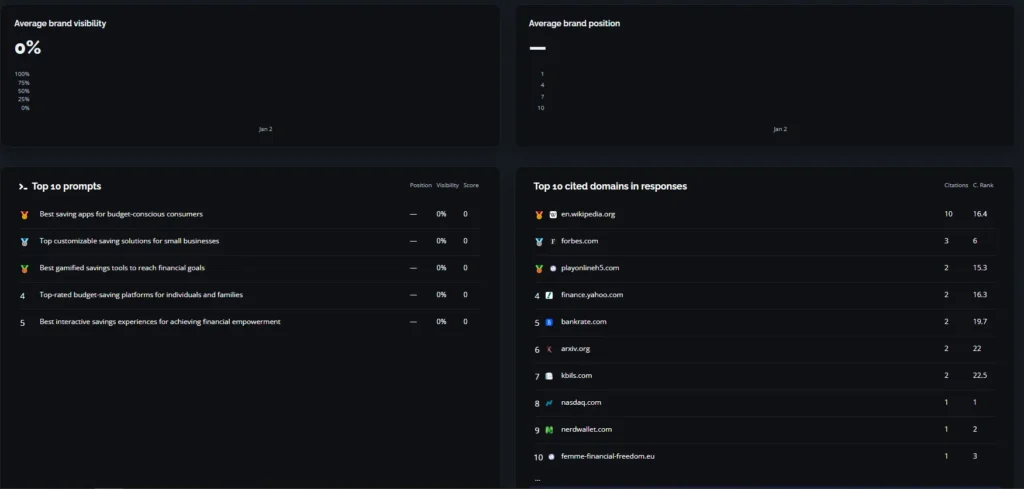
This isn’t just vanity metrics you’re seeing which questions trigger mentions of your brand, which prompts bury you, and where you’re completely absent from the conversation.
For agencies managing multiple clients?
This is gold
You can segment tracking by client, industry, or campaign and pull reports that look professional without drowning in spreadsheets.
Visibility Scores & Average Position Metrics
Remember when ranking #1 on Google was the holy grail?
AI search is different. Position matters, but so does context, prominence, and how the information is framed.
Mangools calculates visibility scores that factor in where your brand appears in the AI response, how prominently you’re mentioned, and whether you’re presented favorably or neutrally.
Average position works similarly to traditional rank tracking lower numbers mean you’re mentioned earlier in the response (which is good).
But unlike Google, where position 1-3 captures most clicks, AI answers are often consumed in full, so even position 5-7 can drive meaningful awareness.
| Prompt | AI Platform | Your Position | Visibility Score | Citation Status |
| Best SEO tools for bloggers | ChatGPT | 3 | 82/100 | Cited with link |
| Affordable keyword research | Gemini | 7 | 54/100 | Mentioned, no link |
| SEO software under $50/month | Perplexity | 2 | 91/100 | Featured comparison |
Integration with SERPWatcher & Other Mangools Tools
One of the smartest moves Mangools made?
They didn’t build AI Search Watcher in a vacuum.
If you’re already using SERPWatcher for traditional rank tracking, you can layer AI visibility data on top of your existing reports.
Same goes for KWFinder you can research keywords, then create AI prompts based on those keywords and track both simultaneously.
The Mangools AI Search Grader workflow is particularly useful for agencies it evaluates keyphrase accuracy, compares AI answers to actual SERP results, and reduces reporting overhead.
You’re not jumping between five different tools to assemble client reports.
Refresh Frequency & Real-Time Monitoring
AI Search Watcher refreshes prompts regularly typically daily or multiple times per week depending on your plan.
You can’t control frequency on a per-prompt basis (at least not yet), but the default cadence is solid for most use cases.
For fast-moving industries or breaking news scenarios, daily updates might feel slow. But for brand monitoring and long-term visibility tracking?
It’s more than sufficient.
Ready to see where you stand in the AI search landscape? Check out Mangools AI Search Watcher and start tracking your first prompts. Your future visibility might depend on it.
The Honest Assessment what Works and What Doesn’t
What I Actually Like About It
The interface is stupid simple: If you’ve ever felt overwhelmed by Ahrefs’ 47 menu options or Semrush’s data dumps, Mangools is refreshing. Everything is color-coded (green = good, red = problem), and you can understand your AI visibility at a glance.
It solves a real blind spot: For the first time, you can quantify whether your brand is visible in AI search results. That’s not a nice to have anymore it’s essential.
The pricing is reasonable: We’ll dig deeper into plans below, but compared to enterprise alternatives, Mangools doesn’t require a second mortgage.
Cross-platform tracking is genuinely useful: Seeing how your visibility differs between ChatGPT and Gemini reveals which AI systems understand your brand better and where you need to focus optimization efforts.
Where It Falls Short
Limited AI platform coverage (for now): As of early 2026, Mangools covers the major players, but niche or emerging AI search engines aren’t always included. If you need hyper-specific coverage, you might hit gaps.
No granular control over prompt refresh timing: I’d love to manually trigger updates for high-priority prompts or increase frequency for specific campaigns. That flexibility isn’t there yet.
It’s not a replacement for traditional rank tracking: This seems obvious, but it’s worth stating: Google blue links still drive the majority of traffic for most sites. AI Search Watcher complements traditional SEO—it doesn’t replace it.
Limited historical data for new accounts: If you’re just starting, you’re building your baseline from scratch.
Some competitors offer historical snapshots, which can be valuable for trend analysis.
Pricing Breakdown Is Mangools AI Search Watcher Worth the Upgrade?
Let’s talk money.
Mangools pricing is tiered, and AI Search Watcher typically requires at least the PRO tier.
Here’s the general structure:
- Basic Plan (~$49/month): Limited or no AI tracking; good for beginners focused on traditional SEO.
- PRO Plan (~$79-$129/month): Full AI Search Watcher access, higher prompt limits, integration with all Mangools tools.
- Agency Plan (~$159+/month): Highest limits, white-label reporting, suitable for managing multiple clients.
Compared to enterprise alternatives like Ahrefs ($199+/month) or Semrush ($139+/month), Mangools is aggressively priced.
You’re not getting every bell and whistle, but for AI visibility tracking plus core SEO tools, the value proposition is strong.
| Plan | Monthly Cost | Tracked Prompts | AI Platforms | Best For |
| Basic | $49 | 25-50 | Limited | Solo bloggers, small sites |
| PRO | $79-$129 | 200+ | Full access | Freelancers, small agencies |
| Agency | $159+ | 500+ | Full access + white-label | Multi-client agencies |
Should Small Businesses Upgrade to PRO?
If you’re a small business owner already using Mangools Basic, the upgrade decision comes down to this: Are you seeing traffic declines that traditional rank tracking can’t explain?
If yes, AI visibility is likely part of the puzzle. Upgrading to PRO gives you visibility into a new traffic channel and helps you understand whether AI search is an opportunity or a threat for your business.
If your traffic is stable and you’re not competing in AI-heavy verticals (e.g., SaaS, tech, digital marketing), you can probably wait another 6-12 months. But if you’re in a knowledge-driven industry where people ask AI assistants for recommendations, the upgrade is worth it.
How Mangools Stacks Up Against Alternatives
You’re probably wondering: should I just use Ahrefs or Semrush instead?
Here’s the truth: Ahrefs Rank Tracker and Semrush Position Tracking are more powerful for traditional SEO. They offer deeper historical data, more granular filters, and enterprise-grade reporting.
But neither has fully embraced AI search visibility the way Mangools has. As of early 2026, Ahrefs and Semrush are still playing catch-up in the AI tracking space. If you need both traditional rank tracking and AI visibility, you’re probably running two tools anyway.
Other alternatives to consider:
AccuRanker – High-frequency rank tracking with advanced segmentation. No AI focus yet.
SE Ranking – Solid all-in-one SEO platform with flexible pricing. AI features are minimal.
Nightwatch SEO – Emphasizes local packs and API access. More technical than Mangools, but no AI tracking.
Nozzle – Highly granular SERP tracking. Great for research, but overkill (and expensive) for most users.
If you’re a small agency or boutique SEO freelancer managing 5-15 clients, Mangools offers the best balance of price, simplicity, and AI-forward features. Larger enterprises might still need Ahrefs or Semrush as their primary tool, with Mangools as a specialized supplement for AI tracking.
Ready to see where you stand in the AI search landscape? Check out Mangools AI Search Watcher and start tracking your first prompts. Your future visibility might depend on it.
Real-World Use Cases: Where AI Search Watcher Excels
Niche Site Owners
You run a portfolio of affiliate sites or content blogs you’ve noticed traffic dips, but your Google rankings are stable.
AI Search Watcher reveals that ChatGPT is now answering the questions your blog posts used to capture, without citing you.
Armed with this data, you can optimize existing content to be more AI-friendly (structured data, clear headings, authoritative citations) or create new content specifically designed to get picked up by AI systems.
Boutique SEO Freelancers
You manage 10 clients and need to justify your value every month traditional rank reports are getting stale because clients see rankings but not results.
AI Search Watcher lets you show clients a new metric: You’re now mentioned in 18 AI answers per month, up from 6 last quarter.
It’s a fresh narrative that demonstrates you’re ahead of the curve.
In-House Marketing Managers
You’re the solo marketer at a mid-sized company, reporting to executives who don’t understand SEO jargon.
AI Search Watcher’s color-coded dashboards (green = good, red = problem) make it easy to communicate wins and losses without a 30-slide deck.
When you show your boss that your brand went from not mentioned to third most cited in AI answers for your industry’s top queries, that’s budget justification gold.
Final Verdict Should You Use Mangools AI Search Watcher?
Here’s where I land after testing this tool extensively:
Mangools AI Search Watcher is essential if:
- You’re in a competitive, knowledge-driven industry where people ask AI assistants for recommendations.
- Your traditional SEO metrics look fine, but traffic or conversions are declining.
- You’re managing clients and need to demonstrate cutting-edge expertise.
- You want a simple, affordable way to track AI visibility without enterprise tool complexity.
You can probably skip it if:
- You’re in a hyper-local business where AI search isn’t a meaningful traffic source (yet).
- Your audience isn’t using AI assistants for research or decision-making.
- You’re already overwhelmed by data and don’t have bandwidth to act on new insights.
The reality?
AI search isn’t going away. Whether it fully replaces traditional Google search or becomes a parallel channel, brands that ignore it are setting themselves up for irrelevance.
Mangools AI Search Watcher gives you a front-row seat to this shift and the data you need to adapt before your competitors do.
Ready to see where you stand in the AI search landscape? Check out Mangools AI Search Watcher and start tracking your first prompts. Your future visibility might depend on it.
Frequently Asked Questions (FAQ)
What is Mangools AI Search Watcher and how does it work across AI search engines like ChatGPT and Gemini?
We covered the basics above, but here’s the technical layer: AI Search Watcher uses automated prompting to query AI search engines with your tracked phrases. It then parses the responses using natural language processing to identify brand mentions, positioning, and citation patterns.
Each AI platform (ChatGPT, Gemini, etc.) is treated as a separate data source, so you can compare how your brand performs across ecosystems. The system logs response variations over time, letting you spot trends like “We’re gaining visibility in ChatGPT but losing ground in Gemini.”
How accurate is Mangools AI Search Watcher in measuring AI answer visibility and citations for my brand?
In my testing, accuracy is solid but not perfect. AI responses can vary based on conversation context, user location, and even time of day. Mangools samples responses and provides aggregate metrics, which smooths out anomalies but means you’re seeing trends, not individual response variations.
For brand monitoring and competitive benchmarking, the accuracy is more than good enough. For ultra-granular analysis (like tracking tiny shifts in citation wording), you might want to supplement with manual checks.
Which AI platforms and regions does Mangools AI Search Watcher currently support?
As of January 2026, Mangools supports ChatGPT, Gemini, and Perplexity as primary platforms. Regional coverage includes major markets like the US, UK, and parts of Europe, with gradual expansion to other regions.
Language support is growing but still weighted toward English. If you’re tracking non-English prompts or region-specific AI behavior (say, German-language visibility in Switzerland), verify current coverage before committing.
How often does AI Search Watcher refresh prompts and rankings, and can I control the frequency?
Default refresh cadence is daily or every few days depending on your plan tier. PRO accounts typically get more frequent updates than basic plans.
Currently, you can’t manually trigger refreshes or customize frequency per prompt. This is a feature I’d love to see added, especially for time-sensitive campaigns or crisis monitoring.
Can Mangools AI Search Watcher integrate with SERPWatcher or other Mangools tools for unified reporting?
Yes, and this is one of the tool’s strongest advantages. AI Search Watcher data flows into the broader Mangools ecosystem, so you can pull unified reports that show both traditional Google rankings (via SERPWatcher) and AI visibility side by side.
The AI Search Grader workflow further streamlines this by automating cross-platform comparisons and highlighting discrepancies between SERP reality and AI answers.
[Insert image: Unified report showing Google rankings + AI visibility metrics in one dashboard]
How does AI Search Watcher calculate average positions, visibility scores, and citation metrics for prompts?
Average position is calculated by analyzing where your brand appears in the AI response sequence. If you’re mentioned in the second sentence of a 10-sentence answer, your position might be scored as “2” or assigned a percentage-based rank.
Visibility scores factor in prominence (bold mentions, featured placements, etc.), context (positive vs neutral vs negative framing), and citation quality (linked source vs passing mention).
Citation metrics track whether your brand is merely mentioned or actually cited with a link back to your site. Full citations are weighted more heavily because they drive referral traffic.
What pricing plans or tiers include AI Search Watcher, and is there a trial or limited free usage?
Mangools offers tiered pricing, with AI Search Watcher typically included in Mangools PRO and higher plans. Basic plans may have limited access or no AI tracking at all.
Pricing starts around $49/month for entry-level plans, with PRO plans in the $79-$129 range depending on limits. There’s usually a free trial (10-day or similar) that lets you test AI Search Watcher before committing.
Check the current Mangools pricing page for exact details, as plans and features evolve.
How many prompts or keyphrases can I track at once with AI Search Watcher on a typical Mangools subscription?
This varies by plan. Basic plans might allow 25-50 tracked prompts, while PRO accounts can handle 200+ prompts or more.
For boutique agencies or niche site owners managing a handful of projects, even the mid-tier limits are sufficient. Larger agencies juggling dozens of clients will want to verify prompt limits before subscribing.
Is Mangools AI Search Watcher suitable for agencies managing multiple clients and thousands of tracked prompts?
Yes, but with caveats. For small-to-medium agencies (5-15 clients), Mangools is excellent. The interface is client-friendly, reports look professional, and the price point is sustainable.
For enterprise agencies tracking thousands of prompts across 50+ clients, you might bump into scaling limits. At that level, you’re probably already using enterprise tools like Ahrefs or Semrush and considering Mangools as a supplementary solution rather than your primary platform.
How does AI Search Watcher handle localization, language differences, and country-specific AI search behavior?
Localization is functional but still maturing. You can specify regions (US, UK, etc.) and Mangools will attempt to simulate AI responses from those geolocations.
Language support beyond English is expanding, but if you’re tracking non-English markets heavily, double-check current capabilities. AI search behavior varies significantly by language and region—what works in English-speaking ChatGPT might not translate directly to Japanese or Spanish markets.
What are the main limitations of Mangools AI Search Watcher compared with traditional rank trackers for Google SERPs?
The big one AI Search Watcher doesn’t track Google blue links. If someone searches on Google and sees 10 organic results, AI Search Watcher isn’t measuring that. You need SERPWatcher for traditional rankings.
AI visibility also doesn’t (yet) correlate perfectly with traffic. You might rank highly in AI answers but see minimal referral traffic if the AI platform doesn’t incentivize clicks. Traditional rank tracking has decades of click-through-rate data; AI visibility is still building those models.
How can AI Search Watcher help identify prompts where my brand is missing or poorly represented in AI answers?
This is where the tool really shines. You can run competitor analysis by tracking prompts where competitors are mentioned but you’re not.
For example, if you’re a project management SaaS and AI Search Watcher shows that prompts like “best tools for remote teams” consistently mention Asana and Monday.com but skip you entirely, that’s a massive red flag. You know exactly which content gaps to fill or which AI optimization strategies to pursue.