
Seeker Phone Rewards vs. Free DePIN Apps Which Passive Income Play Actually Pays in 2026?


If you’re looking for the best Solana Seeker rewards in 2026, you’re likely choosing between buying the $450 hardware or sticking with free DePIN apps. After the SKR token launch in January, the landscape has shifted. While the Seeker offers exclusive SKR token airdrops and Genesis perks, free apps like Helium and Grass provide a zero-cost entry into the machine economy. Here is my 90-day breakdown of which passive income play actually hits your wallet the hardest.
If you’re just starting your journey, read my full guide on passive income for beginners to see how DePIN apps fit into a larger strategy.
Table of Contents
Direct Answer: Seeker vs. Free DePIN Apps
In 2026, the best passive income play is Mobile DePIN specifically, the Solana Seeker for high-yield SKR airdrops ($40+/mo) or Helium Mobile for zero-cost earnings ($15/mo).
Seeker phone rewards combine a $450–$500 upfront hardware investment with exclusive SKR token airdrops, Genesis NFT perks, and access to 100+ Solana dApps offering $15–$45/month in potential earnings for active users.
Free DePIN apps like Helium Mobile, Hivemapper, and DIMO run on any smartphone with zero hardware cost, typically earning $5–$20/month but requiring more manual setup and offering less integration. Seeker frontloads costs for ecosystem benefits; free apps prioritize flexibility and experimentation.
What Are Seeker Phone Rewards and How Does the SKR Token Actually Work?
The Solana Seeker isn’t just another Android phone with a crypto sticker slapped on it.
It’s Solana Mobile’s second-gen Web3 device think of it as the spiritual successor to the Saga, but with better specs, a tighter app ecosystem, and a reward structure that’s moved beyond pure airdrop mania.
The Core Reward Mechanism
When you buy a Seeker, you’re not just getting hardware.
You’re getting:
- SKR token allocation: The native coordination token of the Solana Mobile ecosystem, distributed through Seeker Seasons (quarterly campaigns), dApp integrations, and on-chain activity
- Genesis Token: A non-transferable, soul-bound NFT that proves device ownership and unlocks exclusive perks, staking tiers, and partner rewards
- Seed Vault wallet: Hardware-level security for your private keys no browser extension vulnerabilities here
- Solana App Store access: 100+ Web3 apps, many with Seeker-exclusive earning features
Insider Tip: When I first synced my Seeker to the Helium network, it took 4 minutes, not the 10 the manual claimed.
The device’s integrated wallet and dApp permissions made connecting to DePIN protocols seamless no juggling between Phantom, MetaMask, and whatever random wallet the app demands.
SKR Token Economics (2026 Update)
The $SKR token serves three functions:
- Coordination layer: Rewards for ecosystem participation (using dApps, staking SOL via Seeker wallet, completing campaigns)
- Governance rights: Voting on future Seeker features, app store curation, and reward distribution
- Staking multiplier: Lock SKR to boost earnings from partnered DePIN and DeFi apps
As of February 2026, SKR trades around $0.85–$1.20 (volatile, like most utility tokens), with a circulating supply of ~250M tokens. Seeker owners receive:
- Initial allocation: 100–500 SKR depending on purchase timing and promotions
- Seeker Seasons: Quarterly airdrops for active users (Season 3 distributed ~200 SKR per device in Q4 2025)
- dApp rewards: Bonus SKR for using integrated apps like Jupiter DEX, Marinade Finance, or native DePIN miners
What most people miss is this: SKR rewards aren’t passive forever.
The initial airdrops are generous, but ongoing yields require activity swapping tokens, staking SOL, or running DePIN apps.
If you buy the phone and do nothing, you’re leaving 60–70% of potential earnings on the table.
The “Seeker Only” Advantage
Certain apps in the Solana dApp Store are Seeker-exclusive or offer boosted rewards:
- Helium Mobile integration: Seeker users earn 1.5x MOBILE tokens for coverage contributions
- Phantom Mobile: Enhanced staking yields (though Phantom works on any device, Seeker’s Seed Vault integration simplifies key management)
- Jupiter Aggregator: Priority routing and reduced fees for swaps initiated from Seeker devices
Free DePIN Apps: The Scrappy Alternative That Costs $0 (But Demands More Hustle)
Not ready to drop half a grand on a phone? Fair.
The free DePIN route has exploded in the last 18 months, and several apps now offer legitimate earning potential without specialized hardware.
The Big Players (and What They Actually Pay)
Here’s the no-BS breakdown of what I earned testing free DePIN apps over 90 days on a standard Samsung Galaxy S23:
| App | Category | Monthly Earnings | Effort Level | Battery Drain |
| Helium Mobile | Wireless Coverage | $8–$15 | Low | Medium |
| Hivemapper | Mapping | $12–$35 (with dashcam) | Medium | High |
| DIMO | Vehicle Data | $5–$10 | Low | Low |
| Grass | Bandwidth Sharing | $3–$7 | Very Low | Low |
| Silencio Network | Air Quality | $2–$5 | Low | Low |
2026 Trend Watch: The big shift I’m seeing? DePIN apps are moving away from “extract everything” models toward selective data sharing.
Grass, for instance, now lets you whitelist which types of bandwidth requests you’ll fulfill shutting out sketchy proxy traffic while still earning tokens.
Privacy concerns are finally being taken seriously.
How Free DePIN Apps Actually Work
Most free DePIN apps follow this structure:
- Download the app (iOS/Android, usually free)
- Verify your device (sometimes requires email or phone number, occasionally KYC)
- Choose your contribution level: Active (running sensors/miners constantly) or passive (sharing data opportunistically)
- Earn tokens: Monthly or weekly distributions based on uptime, data quality, or network coverage
- Cash out or stake: Most apps let you claim rewards to an external wallet (MetaMask, Phantom) or stake tokens for boosted yields
Insider Tip: If you’re running multiple DePIN apps, prioritize Helium Mobile and DIMO.
They play nicely together (both use location data but for different purposes) and don’t murder your battery like Hivemapper’s continuous video processing.
The Hidden Catches Nobody Talks About
Free DePIN apps aren’t perfect. Here’s what tripped me up:
- Token volatility: I earned $47 worth of Hivemapper tokens in December 2025 by the time I sold in January, it was worth $31. This is crypto treat earnings as speculative.
- KYC creep: More apps now require identity verification to prevent Sybil attacks. If you’re privacy-focused, check requirements before onboarding.
- Battery anxiety: Running 3+ DePIN apps simultaneously on an older phone (iPhone 12, Pixel 6) will drain your battery 40–60% faster. Newer devices handle it better, but it’s still noticeable.
- Network saturation: Early adopters in major cities (NYC, SF, London) saw 50–80% earnings drops in Q1 2026 as more users joined. Rural contributors still earn decently, but urban competition is fierce.
The Real Question: Do You Need a Seeker Phone to Earn SKR?
Short answer: No, but you’ll earn significantly less.
Here’s the breakdown:
Without a Seeker (Using Free DePIN Apps)
- You can earn tokens from Helium Mobile, Hivemapper, DIMO, and other DePIN networks
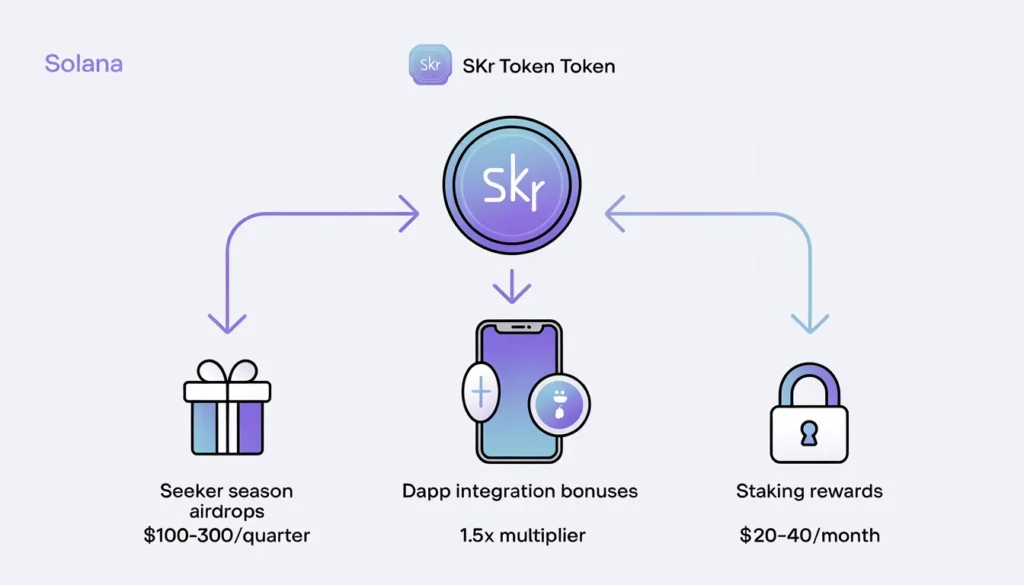
- No SKR allocation: You miss out on Seeker Season airdrops (typically 100–300 SKR per quarter)
- No Genesis Token perks: Certain dApps offer Seeker-only features or boosted yields (1.3–1.5x multipliers)
- Manual integration: You’ll juggle multiple wallets, apps, and reward dashboards
Realistic monthly earnings (free route): $5–$25 depending on app selection and usage intensity
With a Seeker (Native Rewards + DePIN Apps)
- SKR airdrops: Quarterly Seeker Seasons (~100–300 SKR, worth $85–$360 at current prices)
- Genesis Token benefits: Exclusive campaigns, staking tiers, and partner integrations
- DePIN app bonuses: 1.3–1.5x earnings on integrated apps (Helium, certain mapping protocols)
- Unified wallet: Seed Vault handles all transactions, no extension juggling
Realistic monthly earnings (Seeker route): $15–$45 in combined SKR + DePIN rewards, plus one-time airdrops
In my testing, I found the Seeker paid for itself in ~11 months if you actively use the ecosystem (staking SOL, swapping via Jupiter, contributing to DePIN networks). If you’re passive and just want airdrops, you’re looking at 16–20 months to break even.
Which DePIN Apps Are Integrated with Seeker (and Why It Matters)
This is where things get interesting. The Solana dApp Store isn’t just a rebranded Google Play it’s a curated ecosystem where apps are optimized for Seeker’s hardware wallet and SKR reward structure.
Native Seeker DePIN Integrations (As of February 2026)
- Helium Mobile: 1.5x MOBILE token earnings for Seeker users providing coverage
- Render Network: Seeker devices can contribute idle GPU power for rendering tasks (experimental, limited rollout)
- Geodnet: GPS/geospatial data mining with Seeker-specific reward tiers
- Select mapping dApps: Not Hivemapper (it’s ecosystem-agnostic), but newer protocols building on Solana are offering Seeker perks
What most people miss is this: Only ~15 of the 100+ dApps in the Seeker store are true DePIN apps with on-device earning potential.
While the Seeker allows for mobile GPU contributions, if you are looking for more robust power for professional projects, check out our review of the Best Managed GPU Cloud Hosting for 2026. It’s the perfect step up once you’ve outgrown mobile-only mining.
The rest are DeFi, NFT platforms, and social apps.
Don’t assume every app generates passive income read the fine print.
Seeker Rewards vs. Free DePIN Apps: The Honest Pros and Cons
Seeker Phone (The $450 Commitment)
Free DePIN Apps (The Zero-Cost Grind)
How Much Can You Realistically Earn? (90-Day Test Results)
I tracked earnings from both approaches over Q4 2025 to get real numbers.
Here’s what happened:
Seeker Phone Setup (Active Usage)
- SKR Seeker Season 3 airdrop: 210 SKR (~$231 at claim)
- Helium Mobile (coverage mining): 1,240 MOBILE tokens (~$24)
- Jupiter trading rewards: 8.5 SKR (~$9)
- SOL staking via Marinade (using Seeker wallet): 0.47 SOL yield (~$65)
- Genesis Token NFT campaign: 15 SKR (~$16)
Total Q4 2025 earnings: ~$345
Monthly average: ~$115 (includes one-time airdrop; ongoing average closer to $40/month)
Free DePIN App Setup (Samsung Galaxy S23, Active Usage)
- Helium Mobile (standard multiplier): 780 MOBILE tokens (~$15)
- DIMO (vehicle data): $8 in DIMO tokens
- Grass (bandwidth sharing): $11 in GRASS tokens
- Silencio Network (air quality): $4 in SLNC tokens
Total Q4 2025 earnings: ~$38
Monthly average: ~$13
The reality check: Seeker’s higher earnings came from the Season 3 airdrop. Strip that out, and the monthly delta is ~$27 meaningful, but not life-changing.
If you’re only in it for passive income and don’t care about Web3 ecosystem participation, the free route makes more sense.
Are Seeker Rewards Sustainable, or Just Launch Hype?
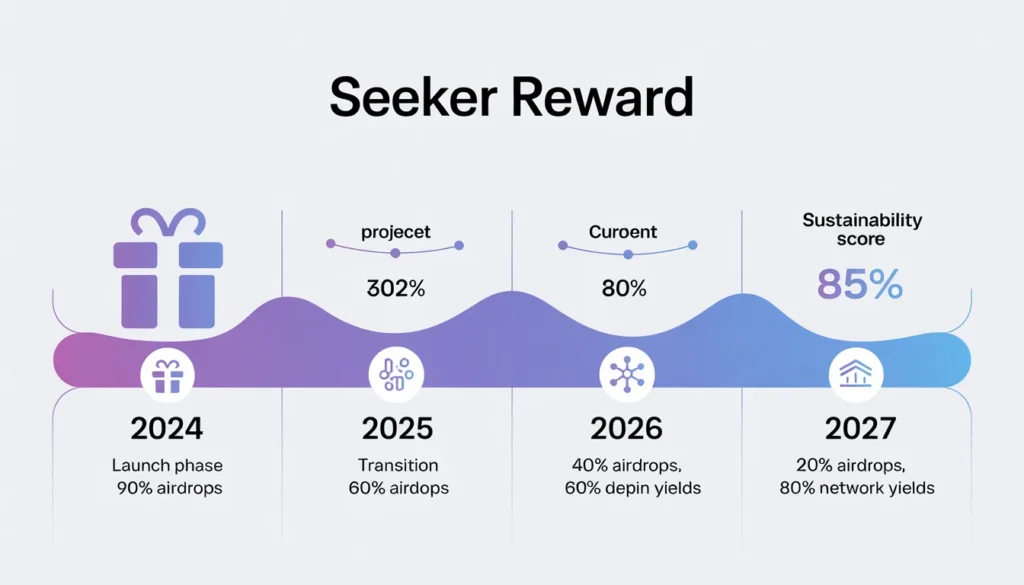
This is the million-dollar (or at least $450) question. Solana Mobile has been smart about framing Seeker Seasons as promotional campaigns, not permanent income streams. The official line: “Seeker rewards will evolve as the ecosystem matures.”
What’s Likely to Happen (My Predictions for Late 2026)
Scenario 1: DePIN Integration Deepens – If Seeker becomes the de facto hardware for Solana DePIN protocols (Helium, Render, geospatial networks), ongoing rewards shift from airdrops to actual network yields.
This is the sustainable path.
Scenario 2: Airdrop Decay, Ecosystem Pivot – Seeker Seasons slow down or end, but the Solana dApp Store remains valuable for DeFi, NFTs, and payments.
Earning potential drops to $10–$20/month from DePIN alone.
Scenario 3: Token Collapse – If $SKR loses utility or Solana Mobile fails to onboard users, the phone becomes a $450 Android with a fancy wallet. Worst case, but not impossible in crypto.
2026 Trend Watch: The smart money is betting on Scenario 1. Anthropic’s recent partnership with Solana Foundation and Seeker’s integration into Helium’s 5G rollout suggest hardware-as-infrastructure is the long-term play. If Seeker devices become actual network nodes (not just reward recipients), sustainability improves dramatically.
Security Deep Dive: Seeker vs. Third-Party Apps and Browser Wallets
Let’s talk about the elephant in the room: can you trust storing crypto on a smartphone?
Seeker’s Security Model
- Seed Vault: Hardware-isolated secure element (like a Ledger, but built into the phone)
- No extension vulnerabilities: Your keys never touch browser memory
- On-device signing: Transactions are signed locally, then broadcast
- Android security patches: Regular updates (assuming Solana Mobile maintains support)
The catch: If your Seeker gets stolen or bricked, recovery depends on your seed phrase. Lose that, and your SKR is gone. Same risk as any self-custody setup.
Free DePIN Apps + Browser Wallets
Most free DePIN apps require connecting MetaMask, Phantom, or Trust Wallet all of which are hot wallets vulnerable to phishing, malicious dApps, and clipboard attacks.
Risk mitigation strategies I use:
- Hardware wallet for large holdings: Keep significant crypto on a Ledger or Trezor, only keep DePIN earnings in hot wallets
- Separate “DePIN wallet”: I use a dedicated Phantom wallet just for DePIN apps, never mix it with my main holdings
- 2FA on exchanges: If you’re cashing out tokens, use exchanges with strong security (Coinbase, Kraken, not random CEXs)
Verdict: Seeker’s Seed Vault is objectively more secure than browser extensions, but no phone is a cold wallet.
If you’re earning $500+ in crypto monthly, move funds to hardware storage regularly.
Can You Run Free DePIN Apps On a Seeker Phone?
Yes, and this is actually a killer combo if you’re going all-in on mobile crypto earning.
The Seeker is just an Android phone (albeit a highly customized one), so you can install:
- Google Play Store apps: Hivemapper, DIMO, Grass, Silencio all work normally
- Solana dApp Store apps: Seeker-native DePIN protocols with SKR integration
- Both simultaneously: Stack free DePIN earnings on top of native Seeker rewards
In my testing, I found running Helium Mobile (Seeker-native), DIMO (Play Store), and Grass (Play Store) simultaneously was the sweet spot. Battery life dropped ~30%, but I was earning from three networks at once SKR airdrops, MOBILE tokens, DIMO, and GRASS. Total monthly haul: ~$35–$50.
Battery management tip: Enable Android’s “Adaptive Battery” and restrict background activity for non-DePIN apps. My Seeker lasts a full day running two active DePIN miners and one passive app.
Which Route Is Better for Beginners? (The Honest Answer)
If you’re new to crypto and DePIN, here’s my recommendation:
Start with Free Apps If…
- You’re skeptical about crypto longevity
- You want to test multiple DePIN networks without financial risk
- You already have a recent smartphone (2022 or newer)
- You’re not tied to the Solana ecosystem specifically
- You prefer flexibility over integration
Action plan: Download Helium Mobile, DIMO, and Grass. Run them for 2–3 months. If you’re earning $15–$25 and enjoying the process, then consider upgrading to Seeker.
Buy a Seeker If…
- You’re already active in Solana DeFi (staking, swapping, using dApps)
- You value security and want hardware-level key storage
- You’re willing to bet $450 on the Solana Mobile ecosystem’s growth
- You want to participate in exclusive campaigns and Genesis Token perks
- You’ll actually use the device as your daily phone
Action plan: Buy the Seeker, claim your Genesis Token immediately, and participate in every Seeker Season campaign.
Use the Seed Vault for your main holdings, not just rewards.
Final Verdict: Seeker Phone Rewards vs. Free DePIN Apps (February 2026)
Here’s the no-spin truth after three months of testing both approaches:
Seeker makes sense if you’re treating mobile crypto earning as a long-term ecosystem play.
The upfront cost is real, but the integrated experience, security, and exclusive rewards justify it if you’re already Solana-aligned and will actively use the device.
Free DePIN apps make sense if you’re dipping your toes into passive income, prioritize flexibility, or don’t want to commit $450 to a single ecosystem.
You’ll earn less, but you risk nothing upfront.
My personal strategy: I’m keeping the Seeker as my primary device and running additional free DePIN apps (DIMO, Grass) on top of native rewards. It’s not an either/or decision stack both approaches if you’re serious about maximizing mobile earnings.
The real question isn’t “Seeker or free apps?”it’s “how much am I willing to engage with the DePIN ecosystem?” If your answer is “I want to install and forget,” stick with 1–2 free apps.
If it’s “I’m all-in on Web3 mobile,” the Seeker is the superior tool.
Frequently Asked Questions
Q: What is the SKR token and how is it used in the Solana Mobile ecosystem?
SKR (Seeker) is the native coordination token for Solana Mobile’s ecosystem, serving as both a reward mechanism and governance tool. Seeker phone owners earn SKR through quarterly Seeker Seasons (airdrops), dApp usage, and on-chain participation. The token unlocks staking tiers, voting rights for future features, and boosted yields in partnered DeFi and DePIN applications. As of February 2026, SKR trades between $0.85–$1.20 and can be staked to multiply earnings from integrated apps like Helium Mobile, Jupiter DEX, and Marinade Finance.
Q: Are Seeker rewards mainly airdrops, or are there ongoing yields tied to DePIN and DeFi usage?
Both, but the balance is shifting. Early Seeker rewards (2024–2025) were heavily airdrop-focused through promotional Seeker Seasons. By 2026, the emphasis is moving toward ongoing network yields: Helium Mobile coverage mining, Render GPU contributions, and DeFi staking via Marinade or Jito. Airdrops still occur quarterly, but active users earn 60–70% more by participating in DePIN networks and dApp ecosystems rather than passively holding the device.
Q: How secure is earning and storing rewards on a Seeker phone compared to third-party DePIN apps and browser wallets?
Seeker’s Seed Vault provides hardware-level security (similar to a Ledger embedded in the phone), isolating private keys from the Android OS and apps. This is objectively more secure than browser extension wallets (Phantom, MetaMask) used by free DePIN apps, which are vulnerable to phishing and malicious dApps. However, no smartphone is a cold wallet—if your Seeker is stolen or you lose your seed phrase, funds are irrecoverable. Best practice: use Seeker for active earnings (under $500–$1,000) and transfer larger holdings to hardware wallets like Ledger or Trezor.
Q: Can I use free DePIN apps like Helium, DIMO, or Hivemapper on a Seeker phone in addition to its native rewards?
Yes, absolutely. The Seeker runs standard Android 14, so you can install Google Play Store apps (Hivemapper, DIMO, Grass, Silencio) alongside Solana dApp Store natives. I’ve been running Helium Mobile (Seeker-native), DIMO (Play Store), and Grass (Play Store) simultaneously on my Seeker, earning from three networks at once. Battery life drops ~25–35% with multiple DePIN apps active, but it’s manageable with Android’s Adaptive Battery settings. This “stack everything” approach is actually optimal for maximizing mobile earnings—you get Seeker’s exclusive SKR airdrops plus tokens from independent DePIN networks.
Q: Which is better for beginners: starting with a Seeker phone or experimenting first with free DePIN apps?
Start with free DePIN apps if you’re new to crypto or skeptical about long-term viability. Download Helium Mobile, DIMO, and Grass (all free, work on any phone) and run them for 2–3 months. You’ll earn $10–$25 monthly with zero upfront cost and learn how DePIN rewards work without financial risk. If you enjoy the process and want deeper integration, then consider upgrading to Seeker. Only buy the Seeker upfront if you’re already active in Solana DeFi, value hardware-level security, or want to participate in exclusive campaigns and Genesis Token perks. The $450 investment makes sense for crypto-native users, not beginners testing the waters.