
Generative Engine Optimization Strategy 2026: The Proven Playbook to Win the AI Search War


To maintain search visibility, businesses must transition to a generative engine optimization strategy in 2026.
As traditional search fades, mastering GEO is the only way to ensure your brand is cited by AI assistants like ChatGPT and Google AI Overviews.
This playbook explains how to build a competitive generative engine optimization strategy for 2026 that drives actual results.
By 2026, the shift is structural. Google AI Overviews appear on the majority of informational queries. ChatGPT handles millions of product research and buying-intent questions every day.
Perplexity has become a default research tool for tech-forward professionals.
And Claude is embedded in enterprise workflows where purchasing decisions are made.
Traditional SEO-optimized title tags, link-building, and keyword density were built for a world where the user types a query and clicks a blue link.
That world still exists, but it is shrinking as a share of total search behavior.
The answer is a discipline called Generative Engine Optimization (GEO): a strategic framework for ensuring your brand, content, and expertise are selected, cited, and surfaced by AI search engines.
This guide covers exactly what that means and how to build a GEO strategy that works in 2026.
Table of Contents
What Is Generative Engine Optimization (GEO)?
Generative Engine Optimization is the practice of structuring your content, brand signals, and technical infrastructure so that large language models (LLMs) and AI-powered search engines retrieve, trust, and cite your content when generating answers.
To understand why GEO matters, you need to understand how AI search engines actually work.
How AI Search Engines Process Queries
When a user submits a query to an LLM-powered search engine, whether that is Google AI Overviews, Perplexity, or ChatGPT with web browsing, the system follows a broadly similar pipeline:
- The query is parsed for intent, entities, and context
- The engine retrieves candidate content from indexed web pages and its training data
- A relevance model selects which sources to draw from
- The LLM synthesises an answer, citing or paraphrasing selected content
- The user receives a generated response, often with source citations
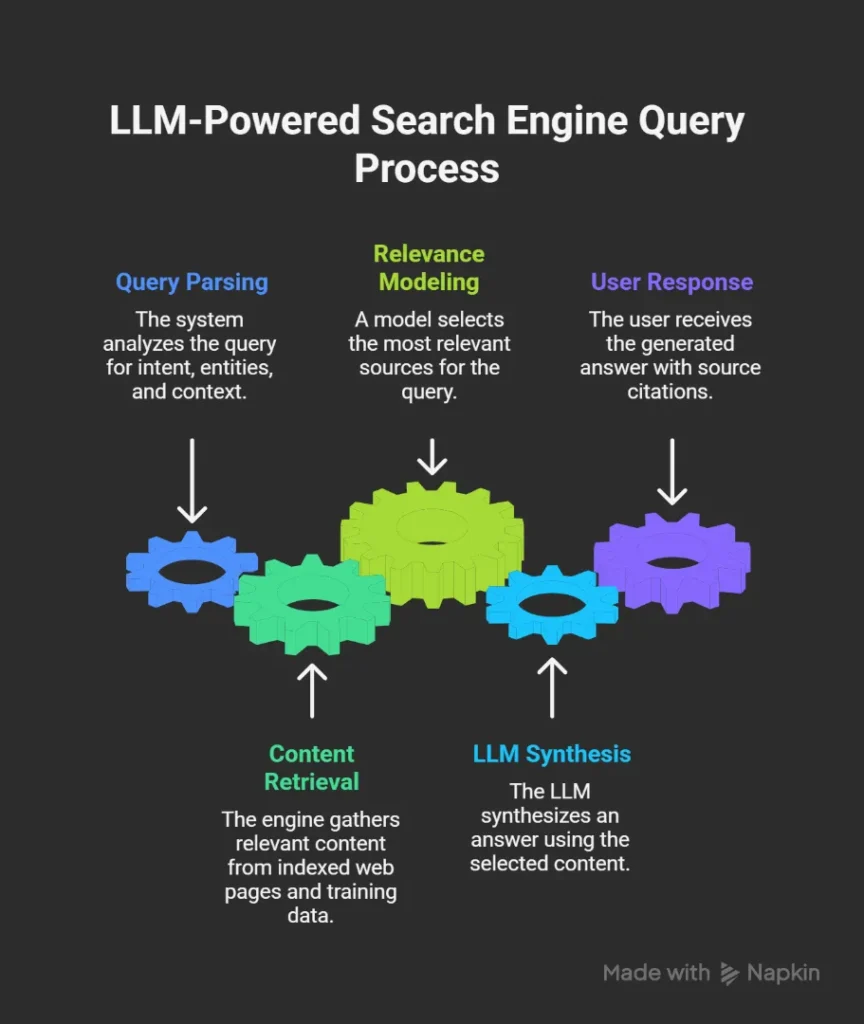
The key difference from traditional search: your page does not need to rank first. It needs to be trusted enough to be cited. That requires a different kind of optimization.
Why 2026 Is Different from 2023 SEO
In 2023, GEO was a niche concern. By 2026, several developments have made it mainstream:
- AI Overviews now appear in Google for a large share of commercial and informational queries, directly cannibalising organic click-through rates
- LLM training data refresh cycles have shortened your recent content can influence model outputs faster than before
- Entity recognition in AI systems has matured significantly, making structured data and knowledge graph signals more important than ever
- Perplexity, Claude, and Gemini have each developed distinct citation behaviours that require platform-specific optimization.
GEO vs Traditional SEO Key Differences
The table below outlines the core distinctions between traditional SEO and a modern GEO strategy in 2026.
| Dimension | Traditional SEO | Generative Engine Optimization (GEO) |
| Ranking signals | Backlinks, domain authority, on-page keywords | Entity authority, citation frequency, semantic depth, structured data |
| Content structure | Keyword-optimised pages, meta tags, title tags | Answer-first content, FAQ schema, concise factual summaries |
| Authority signals | PageRank, link equity, domain age | Knowledge graph presence, brand mentions, corroborated claims across sources |
| Optimisation focus | Rank on page 1 of SERPs | Appear in AI-generated answers, summaries, and citations |
| Traffic model | Click-through to the website. | Zero-click visibility + referral from cited answer |
| Primary channels | Google organic search | ChatGPT, Perplexity, Google AI Overviews, Gemini, Copilot |
| Measurement | Rankings, organic traffic, CTR | AI citation share, brand mention frequency, visibility score |
The practical takeaway: GEO does not replace SEO.
Brands with strong domain authority and high-quality backlinks have a head start in AI citation rankings too.
But GEO requires its own content formats, technical implementation, and measurement approach.
Generative Engine Optimization Strategy 2026 Step-by-Step Framework
Step 1: Entity-Based Optimisation
LLMs reason about the world through entities named concepts, organisations, people, and products that exist in knowledge graphs.
If your brand is not a recognised entity in Google’s Knowledge Graph, Wikidata, or other structured data sources, you are invisible to the systems AI search engines use to validate claims.
Practical actions:
- Claim and verify your Google Knowledge Panel
- Create or improve your Wikidata and Wikipedia presence where justified
- Implement Organization, Person, and Product schema on your website
- Ensure NAP (Name, Address, Phone) consistency across all directories AI systems cross-reference these
- Build entity associations by earning mentions in high-authority publications that are themselves well-indexed
Tool recommendation: Profound tracks your brand entity mentions and citation frequency across 10+ AI engines, the most efficient way to monitor this layer at scale.
Step 2: Semantic Depth and Contextual Coverage
AI search engines favour content that comprehensively addresses a topic, not content tightly optimised for one keyword.
This is semantic SEO 2026 taken to its logical conclusion.
The goal is to become the most complete, trustworthy resource on a given topic so that when an LLM retrieves content for synthesis, your page covers the sub-questions, related entities, and contextual nuances that make a generated answer credible.
Practical actions:
- Use topic clusters rather than standalone pages interconnected content signals semantic authority
- Address natural language questions within your content (who, what, why, how, when)
- Include structured sections that clearly define key terms, compare alternatives, and provide original data
- Use internal linking to connect related concepts this mirrors how knowledge graphs represent relationships
Step 3: AI Citation Optimisation
This is the most GEO-specific step and the one where most brands are currently under-invested.
AI citation optimisation is about formatting content so that LLMs can extract and reproduce it accurately.
LLMs prefer content that is:
- Factually specific containing statistics, dates, named sources, and verifiable claims
- Structured using clear headings, short paragraphs, and FAQ formats
- Authoritative corroborated by citations to primary sources within the content itself
- Answer-first leading with the direct response before the explanation
A useful mental model: write as if you are briefing a researcher who will quote you in a report. Clear, specific, attributable.
Practical actions:
- Add a TL;DR or key findings summary at the top of long-form content
- Use FAQ sections with schema markup these are disproportionately cited in AI Overviews
- Include original statistics or proprietary data that other sources cannot provide
- Cite primary sources within your content AI systems recognise citation patterns as a trust signal
Tool recommendation: Goodie AI offers semantic optimization recommendations specifically designed to improve AI citation rates.
Step 4: Structured Data and Knowledge Signals
Schema markup remains important in 2026, but its role has evolved.
The goal is no longer primarily to earn rich snippets in SERPs it is to give AI systems unambiguous, machine-readable context about your content.
Priority schema types for GEO:
- Article and NewsArticle for editorial and blog content
- FAQPage: High Citation Value in AI Overviews
- HowTo practical guides are frequently cited in instructional AI answers
- Organization and Person entity validation for brand and author authority
- Product and review are critical for e-commerce GEO
- BreadcrumbList and SiteLinks SearchBox structural context
Beyond on-page schema, submit structured sitemaps and ensure your site is crawlable by AI-specific bots: OAI-SearchBot for OpenAI, PerplexityBot, and Googlebot for AI Overviews.
Step 5: Multi-Platform Authority Building
AI systems validate authority by cross-referencing mentions across multiple high-trust sources.
A single well-optimized page is insufficient.
You need a distributed presence.
This is where GEO intersects with PR, content marketing, and digital communications. Earned media placements in authoritative publications do not just drive referral traffic they function as entity corroboration signals for LLMs.
Practical actions:
- Target guest contributions and expert quotes in publications that AI engines index heavily industry trade press, established news sites, academic repositories
- Build data partnerships licensing original research to other organisations creates distributed citations
- Use PR tools like Muck Rack’s Generative Pulse to track how earned media surfaces in AI answers
- Maintain active, consistent profiles on LinkedIn, Crunchbase, and relevant industry directories
Content Designed for AI Retrieval
The final step is the most operational: ensuring your content calendar and editorial process are producing content that AI systems can retrieve, parse, and cite.
Content formats that perform well in AI search:
- Definition posts — clear, specific definitions of industry terms and concepts
- Comparison pages — structured comparisons of tools, approaches, or options
- Step-by-step guides with numbered sections
- Original research and data reports
- Expert roundups with attributed quotes
Refresh frequency matters. Content that becomes stale — outdated statistics, references to superseded tools is deprioritised by AI systems with recency weighting. Build a quarterly content audit into your GEO strategy to identify and update high-value pages.
Tool recommendation: AthenaHQ provides prompt-volume tracking to identify which topics are driving AI query volume — a direct input for content prioritisation.
Common GEO Mistakes in 2026
Most brands entering GEO strategy for the first time make predictable errors.
These are the ones worth avoiding:
- Treating GEO as a search engine ranking exercise. The optimisation target is AI citation, not page position. The content, format, and authority signals required are different.
- Ignoring entity establishment. Producing optimised content on a domain that AI systems cannot identify as an authoritative entity is like writing a well-sourced article under an anonymous byline.
- Over-indexing on schema at the expense of content quality. Schema helps, but AI systems ultimately evaluate the substance and specificity of what is written.
- Neglecting multi-engine monitoring. Visibility in Google AI Overviews and visibility in Perplexity require different signals. A GEO strategy that only tracks one platform is incomplete.
- Failing to measure share of voice in AI answers. Without tracking how often your brand is cited versus competitors, it is impossible to judge GEO progress. Tools like Profound and Geneo address this directly.
- Confusing content volume with semantic depth. Publishing more pages does not improve AI citation rates. Publishing more comprehensive, specific, and trustworthy content does.
- Ignoring the paid search implication. AI Overviews are reducing click-through rates on informational queries, which increases competition for commercial queries. A GEO strategy that does not consider paid search efficiency is missing a critical downstream impact.
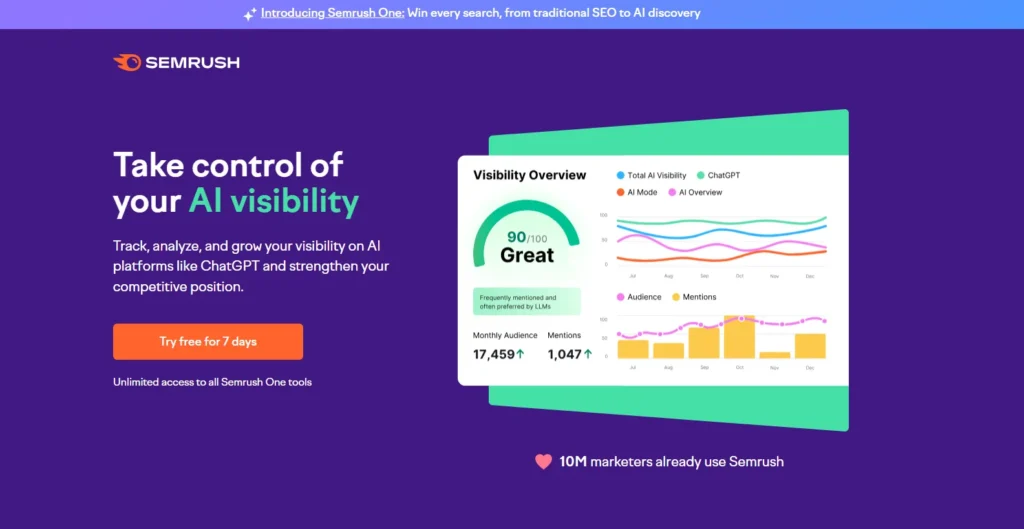
Semrush AI Toolkit — AI Overviews trigger rate data by industry vertical — useful for benchmarking which sectors face the greatest GEO urgency
The Future of GEO 2027 and Beyond
Predicting AI search behaviour more than 12 months out carries real uncertainty.
That said, several trends already in motion will shape GEO strategy in 2027.
Personalised AI Answers
LLMs are moving toward personalised retrieval drawing on user history, stated preferences, and contextual signals to tailor answers.
This will fragment search visibility further, making brand recognition and entity trust even more important than raw citation frequency.
Real-Time Data Integration
Perplexity and Google AI Overviews already pull real-time data for certain query types. As this capability expands, brands with structured, programmatically accessible data APIs, live schema, data feeds will gain citation advantages over those relying solely on static content.
AI Agent Search
As AI agents handle tasks autonomously booking, purchasing, researching they will query LLMs on behalf of users without any human interaction with search results. GEO will need to account for machine-to-machine query patterns, not just human information-seeking behaviour.
Regulatory Pressure on AI Citations
The EU AI Act and evolving platform policies are beginning to shape how AI systems must disclose and attribute sources. Brands that have built strong, verifiable entity signals will be better positioned to benefit from attribution requirements as they tighten.
FAQs
What is the difference between SEO and GEO?
While traditional SEO focuses on ranking a URL in a list of blue links to drive clicks, Generative Engine Optimization (GEO) focuses on becoming the cited source within an AI-generated answer.
SEO targets keywords and backlinks GEO targets entity authority, factual density, and “extractable” content structures.
2. Will GEO replace traditional SEO in 2026?
Answer: No, GEO is an evolution, not a replacement. AI engines still use traditional SEO signals—like domain authority and crawlability—to decide which sites to trust. However, without a specific generative engine optimization strategy, even a #1 ranked site may lose traffic to “Zero-Click” AI summaries that don’t cite them.+1
How do I optimize my content for Perplexity and ChatGPT?
To rank in AI answer engines, use an “Answer-First” architecture. Start each section with a direct 40–60 word response to a specific question. Use bulleted lists, comparison tables, and FAQ Schema (JSON-LD) to make your data machine-readable.
AI models prioritize “snippable” content that is easy to summarize.
Why are brand mentions more important than backlinks in 2026?
In the AI era, LLMs cross-reference information across the web to verify facts.
Frequent, positive mentions of your brand on high-authority sites (Reddit, industry journals, news outlets) serve as “corroboration signals.”
These signals tell the AI that your brand is a trusted entity, making it more likely to be recommended.
How do I measure the success of my GEO strategy?
Success in 2026 is measured by AI Share of Voice (SoV) and Citation Frequency.
Instead of just tracking keyword ranks, use tools to monitor how often your brand is cited in AI responses and track “referral traffic from AI agents” in your analytics to see how many users are clicking through from an AI summary.
Conclusion: Building a GEO Strategy That Holds Up
The brands that will maintain visibility in AI-driven search are not the ones with the most content or the most backlinks.
They are the ones that AI systems can trust, verify, and cite with confidence.
A generative engine optimization strategy for 2026 requires parallel investment in three areas: entity infrastructure (so AI can identify and validate your brand), content quality (so AI has something worth citing), and monitoring (so you can measure and improve your AI citation share over time).
This is not a replacement for SEO.
Your technical foundations, domain authority, and content quality remain relevant.
But layering GEO on top of that foundation with structured data, semantic depth, multi-platform authority, and AI-optimised content formats is what separates brands that remain visible in the next era of search from those that do not.
Start with an audit of your current AI visibility using tools like Profound, Goodie AI, or AthenaHQ. Identify which competitor brands are being cited in your core topic areas.
Then use the six-step framework in this guide to build a systematic response.
Ready to audit your site? Review: Read our SEOWriting.ai Review to start your content pivot.
Track: See our Mangools AI Search Watcher Pro guide to measure your AI citations today.