

A complete AI image generator comparison covering image quality, text rendering, pricing, customization, and real-world use cases so you can make an informed decision fast.
By Savezly Editorial · Updated March 2026 · Category: AI Comparisons · 12 min read
Why Everyone Is Comparing These Two Tools
Ideogram vs Leonardo AI is one of the most searched comparisons in the AI image generation world today.
As AI image generators continue to improve, creators, designers, and marketers are trying to decide which tool actually delivers the best results for their workflow.
Both Ideogram AI and Leonardo AI have gained massive popularity, but they excel in very different areas.
Ideogram focuses heavily on accurate text rendering and graphic design workflows, while Leonardo AI offers a powerful creative suite with advanced models, photorealistic generation, and custom AI training.
In this detailed comparison, we will break down image quality, text rendering, customization, pricing, and real-world use cases to help you choose the best AI image generator in 2026.
If you are still exploring the broader landscape before committing to either platform, our guide to the 12 Best Free AI Image Generators Without Watermarks in 2026 is a great companion read to this comparison.
This article covers every angle image quality, text rendering, customization, ease of use, pricing, and real use cases so you leave with a clear answer, not more confusion.
Table of Contents
Quick Comparison Table
| Feature | Ideogram AI | Leonardo AI |
| Image Quality | High vibrant, design-optimised | High cinematic, photorealistic |
| Text in Images | ⭐ Best-in-class (~90–95% accuracy) | Moderate still inconsistent |
| AI Models | Ideogram 3.0 (May 2025) | Phoenix, Lucid Realism, Kino XL, Anime XL & more |
| Customisation | Style References, Style Codes, palettes | Custom model training, 30+ presets, Elements |
| Ease of Use | ★★★★★ Beginner-friendly | ★★★☆☆ Steeper learning curve |
| Free Plan | ~10 slow images/day | ~150 tokens/day |
| Paid Plans | From $7/month | From $10/month |
| Video Generation | ❌ Not available | ✅ Motion 2.0, Veo 3, Sora 2 |
| 3D Textures | ❌ Not available | ✅ Available for game devs |
| API Access | ✅ Yes | ✅ Yes |
| Best For | Designers, marketers, branded content | Game devs, concept artists, power users |
The table gives you the headlines.
The rest of this guide explains the reasoning behind every rating.
What Is Ideogram AI?
Platform Overview
Ideogram AI was founded in 2022 by Mohammad Norouzi, William Chan, Chitwan Saharia, and Jonathan Ho, four researchers with deep roots at Google Brain.
The platform launched publicly in August 2023 and immediately attracted attention for tackling one of AI’s most persistent failure modes: rendering legible, styled text inside generated images.
The company raised $16.5 million in seed funding from Andreessen Horowitz and Index Ventures, followed by an additional $80 million Series A after the success of version 1.0.
The platform serves millions of creators via web and iOS and has become the go-to tool for any workflow where typography and graphic design quality matter.
Core Features
- Magic Prompt: Automatically enriches your text prompt to improve image detail and coherence
- Style References: Upload up to 3 reference images to define the visual aesthetic of your outputs
- Style Codes: Save exact aesthetic settings as reusable codes for brand consistency
- Colour Palette Control: Specify dominant colours to keep branded content on-tone
- Canvas Editor: Inpainting, outpainting, background removal, and image extension tools
- Negative Prompting: Exclude unwanted elements from your image
- Batch Generation: Available on Pro plans; generate images from a CSV at scale
- API Access: Integrate Ideogram generation directly into your own tools and workflows
Ideogram 3.0: What Changed
Ideogram 3.0 launched on 26 March 2025, with an updated release on 1 May 2025.
The model delivered three major improvements: photorealism, prompt-image alignment, and text rendering accuracy.
Text rendering accuracy reached approximately 90–95% in real-world tests, a dramatic leap compared to the 30–40% accuracy commonly seen in tools like Midjourney.
The key architectural difference is that Ideogram treats character glyphs as semantic tokens rather than visual patterns.
The model understands what letters mean structurally, not just how they look, which is why it consistently produces correctly spelled, properly kerned, contextually integrated text.
The 3.0 update also introduced Style References, letting creators upload visual mood boards to guide generation style without relying purely on text prompts. In independent human evaluations, Ideogram 3.0 achieved the highest ELO rating across a diverse range of prompts.
Where Ideogram AI Wins: Typography and Graphic Design
Ideogram’s defining edge is typography.
For designers creating posters, ad banners, social media graphics, book covers, T-shirt designs, and product packaging, Ideogram removes one of the most time-consuming steps in AI-assisted design: fixing unreadable text in post-production.
The platform handles handwritten fonts, 3D lettering, graffiti scripts, multi-line compositions, and bilingual layouts with a reliability no other mainstream AI image tool currently matches at scale.
Best Use Cases for Ideogram AI
- Marketing materials and ad banners requiring accurate branded text
- Social media graphics for Instagram, LinkedIn, Pinterest, and X
- Poster design, book covers, and product packaging concepts
- Logo ideation and graphic design mockups
- T-shirt designs, merchandise, and print-on-demand assets
- Branded content requiring style consistency across campaigns
🔗 Related Reading on Savezly:
- 12 Best Free AI Image Generators Without Watermarks in 2026
- 10 Best Free AI Tools in 2026 (Tested): ChatGPT, Claude, Perplexity & More
- Browse All AI Tools Reviews →
What Is Leonardo AI?

Platform Overview
Leonardo AI launched in 2022 specifically to help game developers and 3D artists create visual assets faster.
That origin still shapes the product: rather than offering a single clean generation experience, Leonardo AI is a comprehensive creative studio with a wide surface area.
In July 2024, Canva acquired Leonardo AI, adding significant resource backing and integration potential. By early 2025, the platform had surpassed 30 million registered users.
Beyond image generation, Leonardo now offers video creation, 3D texture generation, custom AI model training, image editing, background removal, and a multi-model library all under one subscription.
Leonardo Phoenix: The Flagship Model
Phoenix is Leonardo’s most capable image generation model.
It delivers significantly improved prompt adherence, cinematic image quality, and better text generation compared to earlier Leonardo models. Two standout features arrived with Phoenix: Prompt Enhance, which auto-expands simple prompts into detailed descriptions, and Edit with AI, which allows targeted in-image edits via natural language commands.
The Full Model Library
Where Leonardo genuinely stands apart is model diversity. Available models include:
- Lucid Origin and Lucid Realism: Versatile all-rounders for cinematic daily work
- Leonardo Phoenix: Flagship model for complex compositions and prompt adherence
- Leonardo Kino XL: Specialised for film-style cinematic lighting
- Leonardo Anime XL: Purpose-built for anime and manga aesthetics
- Seedream 4.0: Native 4K generation for commercial photography
- Ideogram 3.0 (available within Leonardo): Typography specialist for text-heavy designs
- Community fine-tuned models: Hundreds of user-trained models for niche styles
💡 Worth noting: Ideogram 3.0 is actually available as a selectable model inside Leonardo AI’s own platform, a clear acknowledgment of Ideogram’s unmatched text rendering superiority.
Custom AI Model Training
This is the feature that makes Leonardo indispensable for game studios, brand agencies, and production teams. Upload a curated image dataset, define the style or character you want the model to learn, and generate outputs that maintain deep visual consistency. No other mainstream AI image generator at this price point offers this capability.
Style Presets and Advanced Controls
Leonardo provides over 30 built-in style presets spanning architectural photography, fantasy illustration, anime, product photography, and more. Advanced users can adjust guidance scale, inference steps, scheduler type, and seed values the kind of technical controls that appeal to developers and production pipelines.
Best Use Cases for Leonardo AI
- Game concept art and consistent character design
- Cinematic illustration and film-style poster art
- 3D texture generation for game and product assets
- AI video creation with Motion 2.0, Veo 3, and Sora 2
- Custom model training for brand or character consistency at scale
- Photorealistic product photography and commercial mockups
Image Quality Comparison
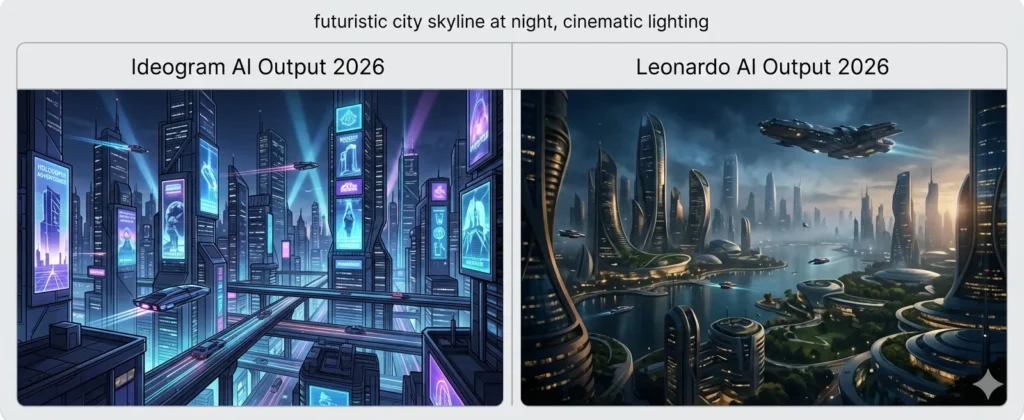
Both platforms generate high-quality images.
The question is what kind of quality matters for your specific workflow.
| Quality Aspect | Ideogram AI | Leonardo AI | Winner |
| Photorealism | Good improved in v3.0 | Excellent PhotoReal & Lucid models | 🏆 Leonardo |
| Artistic Styles | Design-focused, clean | Cinematic, fine art, anime | 🏆 Leonardo |
| Colour Accuracy | Vibrant, slightly stylised | Natural, cinema-grade tones | Tie |
| Detail & Texture | Sharp for 2D / flat design | Superior for complex scenes | 🏆 Leonardo |
| Typography in Image | Best-in-class accuracy | Moderate often garbled | 🏆 Ideogram |
| Style Consistency | Strong via Style Codes | Excellent with custom models | Tie |
| Prompt Adherence | Very high in v3.0 | Very high in Phoenix | Tie |
Realism
Leonardo AI holds a clear advantage in photorealism.
The PhotoReal mode, Lucid Realism model, and Seedream 4.0 are all engineered for hyper-realistic output accurate lighting, natural textures, convincing depth of field, and believable human subjects.
For commercial photography mockups, architectural visualisation, or portrait-style work, Leonardo delivers results that can pass for professional photography.
Ideogram 3.0 improved photorealism meaningfully from earlier versions.
Product shots and scene compositions are polished. However, Ideogram images tend to carry a slight graphic-design aesthetic clean, bold, saturated that reads as designed rather than photographed. Complex multi-person scenes remain a weakness, where proportion inconsistencies and skin textures can appear off.
Colour Accuracy and Artistic Styles
Ideogram produces vivid, brand-friendly colour palettes with precise control via the colour palette feature. Leonardo offers more naturalistic colour rendering by default, with cinema-grade grading that suits editorial and concept art.
Leonardo’s model library also enables a far wider spectrum of artistic style from oil painting to anime to editorial photography in a way Ideogram’s single-model architecture currently cannot match.
Detail and Texture
For complex multi-layered scenes, Leonardo’s Seedream 4.0 delivers native 4K imagery with deep texture fidelity that Ideogram currently cannot match at the same resolution.
For flat design, poster art, and two-dimensional graphic compositions, the difference is significantly smaller and Ideogram often looks crisper.
Text Rendering Comparison
This is the category that most clearly separates the two platforms and the margin is not close.
Ideogram AI achieves approximately 90–95% text rendering accuracy including correctly spelt words, appropriate letter spacing, natural integration with the visual scene, and support for diverse font styles: handwritten, 3D, graffiti, serif, sans-serif, and script.
The technical reason for this lead is architectural.
Ideogram treats character glyphs as distinct semantic tokens the model understands what letters are and how they behave structurally, not just visually.
🏆 Winner: Ideogram AI and it is not close
- Midjourney text accuracy: ~30–40%
- DALL-E 3: better, but inconsistent
- Ideogram 3.0: ~90–95%
If your project includes any text a poster headline, a product label, a social caption, a logo Ideogram is the only AI tool that handles this reliably enough for professional production.
Leonardo Phoenix made real progress in text generation, and for short phrases in clean conditions it can produce legible results.
But across real-world usage longer compositions, unusual fonts, multi-line layouts, text on textured backgrounds Leonardo remains unpredictable.
The standard workaround among Leonardo users is to generate the text-free visual in Leonardo, then add typography in Figma, Canva, or Photoshop.
That is a valid workflow, but it adds friction and time.
For any creator who regularly works with text inside images marketers, social media designers, brand teams Ideogram AI is the decisive choice on this single criterion alone.
Customisation and Model Flexibility
Ideogram AI Customisation
Ideogram offers targeted customisation tools optimised for design consistency rather than technical depth. Style References allow you to upload up to three reference images to define the visual aesthetic of your generations mood, colour, composition, and texture.
Style Codes let you save and reuse these exact aesthetic settings across future projects without re-uploading references each time.
The Canvas Editor adds inpainting, outpainting, background removal, and the Extend Image feature. These are efficiency tools designed for fast creative iteration rather than deep technical control.
Leonardo AI Customisation
Leonardo’s customisation capabilities are substantially deeper.
The custom model training feature allows you to train a personalised AI model on your own image dataset your specific characters, environments, art styles, or product aesthetics.
This is a professional-grade capability with no equivalent in Ideogram’s current offering.
Beyond custom models, Leonardo gives users direct access to generation parameters: guidance scale, inference steps, scheduler type, negative weight, and seed values.
These controls matter for reproducible, precise results particularly for developers integrating Leonardo into creative production pipelines.
The Elements system further allows layered style mixing, blending multiple aesthetic influences into a single generation.
💡 Customisation Verdict
Leonardo AI wins this category clearly for power users who need custom model training and deep parameter control. Ideogram wins for creators who need brand-consistent results fast, without a technical learning curve.
8. Ease of Use and Interface
Ideogram AI
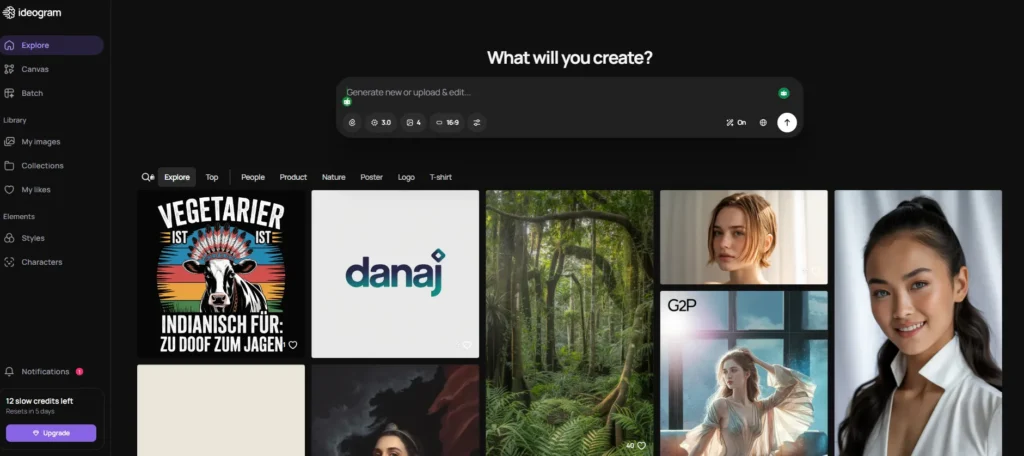
Ideogram’s interface is deliberately minimal.
You land on a prompt box, choose a style (Realistic, Design, 3D, Anime, General), set your aspect ratio, and generate.
There are no overwhelming sidebars or advanced parameter panels on the main screen.
For beginners and creators who want fast, quality results without configuration overhead, this is a significant advantage.
Magic Prompt reduces the need for advanced prompt engineering by automatically expanding and improving vague inputs.
If you want to craft stronger prompts before you start generating, the free AI Prompt Generator on Savezly is a practical companion tool.
Leonardo AI
Leonardo’s interface is significantly more complex.
The left sidebar contains multiple tool categories AI Canvas, Image Generation, Image Guidance, Motion, 3D Texture, and more.
First-time users frequently feel overwhelmed by the sheer volume of options, model choices, and parameter settings visible on screen.
That complexity is a deliberate design choice.
Leonardo is built for power users who want precise control.
Once you invest a few hours learning the platform guided by its in-app tooltips, community templates, and example gallery the depth rewards the investment.
But there is a real, non-trivial learning curve that Ideogram simply does not have.
📊 Ease of Use Summary
| Ideogram AI | Leonardo AI | |
| Onboarding time | ~5 minutes | ~2–4 hours |
| Technical knowledge needed | None | Moderate |
| Mobile app | ✅ iOS | ❌ None |
| Best for | Beginners, marketers | Power users, developers |
Pricing Comparison
Both platforms offer free tiers and paid subscriptions.
Here is a clear breakdown of what you actually get at each level.
| Plan | Ideogram AI | Leonardo AI |
| Free Tier | ~10 slow images/day; community gallery | ~150 tokens/day; limited features |
| Entry Paid | $7/month 400 priority credits (Basic) | $10/month standard features (Apprentice) |
| Mid Tier | $16/month 1,000 credits + private gen. (Plus) | $24/month more tokens (Artisan) |
| Pro | $48/month 3,000 credits + batch gen. | $48/month unlimited options (Maestro) |
| Commercial Use | Plus plan ($16/mo) and above | Apprentice ($10/mo) and above |
| API | Paid plans token-based | Paid plans token-based |
| Value Rating | ★★★★★ Best value per image | ★★★☆☆ Better for feature breadth |
Ideogram AI Pricing Notes
Ideogram’s pricing is straightforward.
The free tier provides 10 slow-generation credits per day enough to evaluate the platform but not for production use.
The Basic plan at $7/month (billed annually) unlocks 400 priority credits per month, PNG downloads, and access to the Ideogram Editor.
The Plus plan at $16/month adds 1,000 priority credits, private generations, image uploads, and colour palette control the minimum recommended tier for commercial or agency work.
Leonardo AI Pricing Notes
Leonardo uses a token system where different actions consume credits at different rates.
Simple image generation is efficient, but video generation and high-resolution outputs consume tokens significantly faster.
The free tier provides approximately 150 tokens per day enough for limited testing.
The Apprentice plan at $10/month is the effective starting point for serious use.
Cost efficiency note: For equivalent image output volume, Ideogram’s pricing runs approximately 30–35% lower than comparable Leonardo tiers.
However, Leonardo’s additional capabilities video generation, 3D textures, and custom model training justify the higher price for power users who actively use those features.
Pros and Cons
Ideogram AI
| ✅ Pros | ❌ Cons |
| Best-in-class text rendering (~90–95%) | No video generation capability |
| Very beginner-friendly interface | No custom AI model training |
| Style References and Style Codes for brand consistency | Weaker photorealism for portraits and complex scenes |
| Fast generation (5–20 seconds) | Limited free tier (10 slow images/day) |
| Most affordable pricing across all tiers | Narrower model diversity than Leonardo |
| iOS mobile app available | Multi-person scenes can show proportion issues |
| Strong prompt adherence in v3.0 | Less suited for highly detailed cinematic work |
Leonardo AI
| ✅ Pros | ❌ Cons |
| Superior photorealism with PhotoReal and Lucid models | Unreliable text rendering needs external tools |
| Custom AI model training on your own datasets | Steeper learning curve for new users |
| Video generation via Motion 2.0, Veo 3, and Sora 2 | Complex token system can be confusing |
| 3D texture generation for game and product assets | Higher pricing for equivalent image volume |
| 30+ specialised models and style presets | Token usage spikes with video and HD features |
| Deep parameter controls for developers | No dedicated mobile app |
| Backed by Canva large community and active development | Interface can feel overwhelming initially |
Best Use Cases
For Graphic Designers
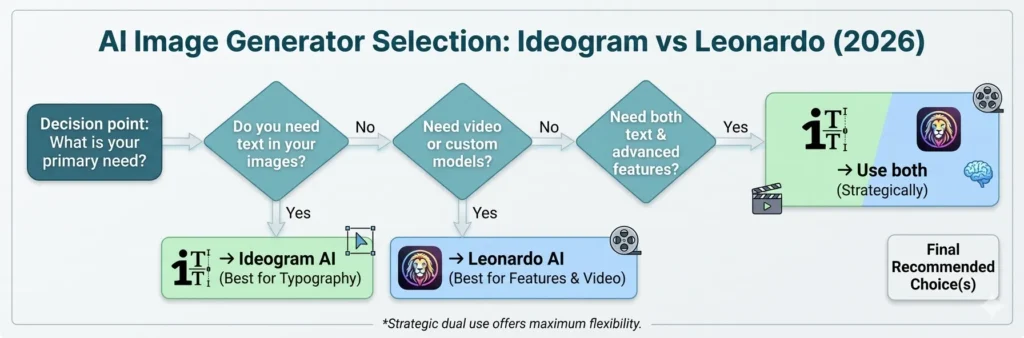
Ideogram AI is the stronger choice for graphic designers working on print materials, social media assets, and branded content.
Its typography capabilities eliminate the most time-consuming post-production step in AI-assisted design. Leonardo AI is better for designers doing concept art, visual development for games and film, or any work requiring custom model training for consistent characters and environments.
For Marketing Content
Ideogram AI wins for marketing professionals. Creating ad banners, promotional posters, product graphics, and social content with specific brand text product names, slogans, CTAs is significantly faster and more reliable in Ideogram.
Pair it with the free AI Social Media Post Generator and SEO Meta Assistant on Savezly to complete your content workflow without leaving the browser.
For Social Media Images
Both tools serve social media well, but the right choice depends on content type.
If your posts regularly include text overlays, quote cards, or branded captions built into the image, Ideogram is the clear choice.
If you are creating purely visual content lifestyle photography, cinematic stills, character imagery Leonardo’s photorealistic models produce more compelling results.
For Game Concept Art
Leonardo AI is the clear choice for game developers and concept artists.
Custom model training for specific characters and environments, combined with specialised cinematic and 3D texture models, makes it the industry-standard tool in this category.
Many professional studios use Leonardo as their primary AI-assisted concept art pipeline.
For AI Artists and Illustrators
For AI artists and digital illustrators, Leonardo’s creative depth supports a more experimental, expressive process.
The multi-model approach, custom training, and fine-grained parameter control reward exploration. Ideogram remains a strong secondary tool for artists who incorporate graphic design or typography elements in their work.
🔗 Savezly Tools to Complete Your AI Creative Workflow:
- Free AI Prompt Generator — Build better prompts for Ideogram & Leonardo
- AI Social Media Post Generator — Turn your images into viral captions
- SEO Meta Assistant — Generate meta tags for your AI content
- Generative Engine Optimization Strategy 2026 — Rank in AI Search
Final Verdict
There is no single winner only the right tool for your specific workflow.
The question is not which platform is technically superior overall, but which one solves the problem you actually need to solve today.
Choose Ideogram AI if your work regularly involves text inside images.
No other AI tool on the market comes close to Ideogram’s typography accuracy.
It is also the better choice if you are new to AI image generation, work in a fast-paced marketing or design environment, or simply want a clean, affordable tool that delivers quality results without configuration overhead. At $7–$16 per month for a paid plan, it is also the more cost-efficient option for pure image output volume.
Choose Leonardo AI if you need the full creative studio experience.
Custom model training, video generation, 3D texture creation, photorealistic output, and a deep library of specialised models make it the right choice for game developers, concept artists, advanced creatives, and production teams who regularly push AI generation to its technical limits.
For many professional creators, the practical answer is both.
Use Ideogram for text-forward design work and fast branded content.
Use Leonardo for complex imagery, custom characters, and cinematic or photorealistic projects.
At their respective price points, running both platforms simultaneously is affordable and strategically sound.
Frequently Asked Questions
Is Ideogram AI better than Leonardo AI in 2026?
It depends entirely on your use case.
Ideogram AI is better for text rendering, graphic design, and marketing content where typography accuracy is critical.
Leonardo AI is better for photorealism, game concept art, video generation, and users who want custom AI model training.
Neither is objectively superior they lead in different categories, and many serious creators use both.
Which AI image generator has the best text rendering in 2026?
Ideogram AI leads in text rendering by a significant margin.
Ideogram 3.0 achieves approximately 90–95% text accuracy with correctly spelt, stylistically appropriate, contextually integrated typography.
Competing tools, including Midjourney and Leonardo AI, produce garbled or inaccurate text far more frequently.
Our 12 Best Free AI Image Generators guide covers the broader landscape if you want to compare more tools.
What is Leonardo Phoenix and how good is it?
Leonardo Phoenix is Leonardo AI’s flagship image generation model.
It delivers improved prompt adherence, enhanced image quality, and better text generation than earlier Leonardo models.
It introduced the Prompt Enhance and Edit with AI features.
Phoenix is one of several models available within Leonardo AI, alongside Lucid Realism, Kino XL, Anime XL, and Seedream 4.0.
Can you use Ideogram AI for free?
Yes.
Ideogram AI’s free tier provides approximately 10 slow-generation credits per day enough to explore the platform but insufficient for production use.
Paid plans start at $7 per month (billed annually) for 400 priority credits, with commercial rights available from the Plus plan at $16/month.
Does Leonardo AI have a free plan?
Yes.
Leonardo AI’s free plan provides approximately 150 tokens per day, covering limited image generation.
It does not include private generations or access to all models.
Paid plans start at $10 per month (Apprentice tier) for full platform access.
Which is better for social media content Ideogram or Leonardo AI?
For social media content that includes text, quotes, or branded captions built into the image, Ideogram AI is the better choice due to its superior text rendering accuracy.
For purely visual content lifestyle photography, cinematic stills, character imagery Leonardo AI’s photorealistic models produce more compelling results.
Use Savezly’s free AI Social Media Post Generator to turn any generated image into a ready-to-publish caption in seconds.
Can Leonardo AI generate videos?
Yes.
Leonardo AI offers video generation through Motion 2.0, which animates still images into short video clips, as well as integrations with Veo 3, Sora 2, and Kling 2.5 for more advanced video creation.
Ideogram AI does not currently offer any video generation functionality.
How do I write better prompts for AI image generators?
Both Ideogram and Leonardo benefit from detailed, specific prompts.
Ideogram’s Magic Prompt and Leonardo’s Prompt Enhance automatically improve vague inputs.
For creators who want to craft stronger prompts before generating, Savezly’s free AI Prompt Generator is specifically designed to help you build rich, effective descriptions for any AI image tool.
🔗 More from Savezly’s AI Comparisons & Tools:
- 12 Best Free AI Image Generators Without Watermarks in 2026
- 10 Best Free AI Tools in 2026 (Tested): ChatGPT, Claude, Perplexity & More
- Generative Engine Optimization Strategy 2026
- Free AI Prompt Generator
- AI Social Media Post Generator
- SEO Meta Assistant
- Browse All AI Comparisons →
- Browse All AI Tools Reviews →