
Category: AI Cloud & GPU · AI Comparisons
Reading time: ~10 minutes
For: Developers · ML Engineers · AI Researchers · Startups
Why Choosing the Right GPU Cloud Can Make or Break Your AI Project
The GPU cloud you choose directly affects your training speed, budget runway, and deployment reliability.
A wrong choice can mean paying 3× too much for the same compute, waiting hours for instances to spin up, or losing a 72-hour training run to an unexpected spotty interruption.
In 2026, the two platforms that keep coming up in conversations among developers, ML engineers, and AI startups are RunPod and Lambda GPU.
Both offer on-demand NVIDIA GPU access at competitive prices, but they are built for very different users and very different workloads.
This comparison cuts through the noise.
Whether you are training an LLM, running Stable Diffusion, fine-tuning a model, or serving inference at scale, we will show you exactly which platform fits your needs.
For a broader view of the GPU cloud landscape, our guide to the Best GPU Cloud Providers for AI in 2026 covers all major players, including CoreWeave, AWS, and Lambda, at an engineering level.
Quick Answer: RunPod wins on price, GPU variety, and flexibility. Lambda GPU wins on reliability, compliance, and research infrastructure.
Read on for the full breakdown.
Table of Contents
RunPod vs Lambda GPU: Quick Comparison Table (2026)
| Category | RunPod | Lambda GPU |
| Starting Price | ~$0.20/hr (RTX 3070) | ~$0.50/hr (A10) |
| RTX 4090 | ✅ Available (spot & on-demand) | ❌ Not available |
| A100 80GB | ✅ Available | ✅ Available |
| H100 SXM | ✅ Available | ✅ Available |
| Ease of Use | ⭐⭐⭐⭐ Moderate learning curve | ⭐⭐⭐⭐⭐ Very beginner-friendly |
| Deployment Speed | ~30–90 seconds | ~2–5 minutes |
| Spot Instances | ✅ Yes (save 40–60%) | ❌ No |
| Serverless GPU | ✅ Yes | ❌ No |
| Persistent Storage | ✅ Network volumes | ✅ Persistent filesystems |
| SOC 2 Compliance | ❌ Limited | ✅ SOC 2 Type II |
| Best For | Budget training, Stable Diffusion, inference startups | Research labs, LLM training, enterprise teams |
💡 Related Guide: The Ultimate Guide to Cheap GPU Cloud — Save 40–70% on AI Training Costs
RunPod: Overview, Features, and Pricing
What Is RunPod?
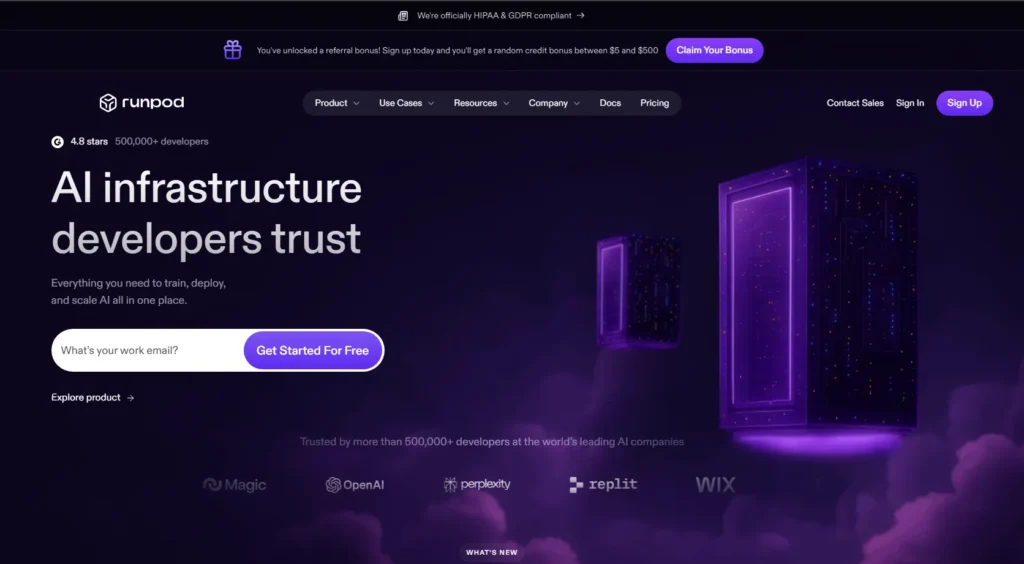
RunPod is a GPU cloud marketplace launched in 2022 that has rapidly grown into one of the most popular platforms among AI developers and researchers.
It works like a marketplace GPU hosts (data centers and private operators) list their capacity, and you rent it by the hour. Competition between hosts keeps prices low and hardware variety high.
RunPod is the go-to platform for indie developers, Stable Diffusion artists, and cost-conscious startups. It is also one of the few clouds where you can rent an RTX 4090 at a fraction of what a data center GPU costs.
If you are comparing consumer GPUs for local vs. cloud use, our RTX 5090 vs 4090 for AI guide explains why VRAM matters more than raw specs for most AI workloads.
Key Features of RunPod
- Spot and on-demand GPU pods: spot instances save 40–60% but can be interrupted
- Serverless GPU endpoints: deploy inference APIs that scale to zero, paying only per request
- 20+ GPU types: from RTX 3070 to H100 80GB SXM clusters
- Pre-built templates: PyTorch, TensorFlow, Stable Diffusion (AUTOMATIC1111, ComfyUI), and more
- Network volumes: persistent storage across pod sessions
- Custom Docker container support: bring your own environment
- Community Cloud and Secure Cloud tiers: cheaper but variable vs. more stable at higher price
- REST API: programmatic pod management and auto-scaling
GPU Types Available on RunPod
| Category | GPU Models |
| Consumer GPUs | RTX 3070, 3080, 3090, 4070, 4080, 4090 |
| Professional GPUs | RTX A4000, A5000, A6000 (48GB) |
| Data Center GPUs | A10, A30, A100 40GB, A100 80GB, H100 PCIe, H100 SXM |
| Multi-GPU Clusters | Up to 8× H100 SXM |
RunPod Pricing Model
RunPod uses a simple hourly pay-as-you-go model with no subscriptions or minimum commitment.
Spot instances are cheapest but carry interruption risk.
On-demand pods are stable.
Secure Cloud adds a premium for better hardware reliability. Storage costs approximately $0.07/GB/month on network volumes.
Best Use Cases for RunPod
- Stable Diffusion, ComfyUI, and AI image generation workflows
- LLM inference and serverless API serving with auto-scaling
- Budget-conscious model fine-tuning and rapid experimentation
- Startups needing maximum compute per dollar with flexible pricing
- Rapid prototyping that requires fast pod spin-up (under 90 seconds)
🔗 See Also: Vast.ai vs RunPod (2026) — Full comparison of two budget GPU marketplaces
Lambda GPU Cloud: Overview, Features, and Pricing
What Is Lambda GPU Cloud?
Lambda GPU Cloud, operated by Lambda Labs, is a professional-grade GPU cloud service designed specifically for AI researchers, ML engineers, and enterprise teams.
Lambda Labs started as a GPU workstation hardware company in 2012 and launched their cloud platform as a natural extension for teams needing more compute than a workstation can provide.
Lambda GPU takes a curated, reliability-first approach: fewer GPU options, but stronger infrastructure guarantees.
It is the preferred platform for university research labs, AI teams at funded startups, and enterprise ML teams running long-horizon training jobs.
For a comprehensive comparison of all managed platforms including Lambda, see our Best Managed GPU Cloud Hosting review.
Key Features of Lambda GPU Cloud
- On-demand + reserved contracts 1-month and 1-year options with up to 40% savings
- Lambda Stack pre-installed PyTorch, TensorFlow, CUDA, cuDNN zero environment setup time
- Persistent filesystem storage included with every instance by default
- Clean dashboard Jupyter Notebook and SSH access out of the box
- Team sharing features for collaborative research environments
- SOC 2 Type II compliance for enterprise and regulated data environments
- CLI and API access automation and scripting support
- GH200 Grace Hopper Superchip available for memory-intensive frontier workloads
GPU Types Available on Lambda GPU Cloud
| Category | GPU Models |
| Available GPUs | A10 (24GB), A100 (40GB), A100 (80GB), H100 PCIe (80GB), H100 SXM (80GB), GH200, 8× H100 clusters |
| Not Available | RTX 4090 or any consumer GPU |
⚠️ Note: Lambda does not offer consumer GPUs like the RTX 4090.
This limits budget-tier options but improves overall infrastructure reliability and consistency.
Lambda GPU Pricing Model
Lambda uses straightforward hourly on-demand pricing with no hidden fees.
Reserved instances (1-month or 1-year) deliver up to 40% savings an H100 SXM reserved annually drops to around $2.20/hr vs. $2.99/hr on-demand.
No spot instances means no interruptions, critical for long training runs where losing progress is costly.
Best Use Cases for Lambda GPU
- Large-scale LLM training and transformer fine-tuning
- University research requiring stable, reproducible compute environments
- Enterprise AI teams with SOC 2 compliance requirements
- Long multi-day distributed training runs where interruption equals wasted cost
- Teams that prioritize zero environment setup over maximum cost flexibility
Performance Comparison: RunPod vs Lambda GPU

Raw GPU specs are just the starting point.
The surrounding infrastructure network speed, storage I/O, deployment reliability, and cluster interconnect determines how much of that theoretical performance you actually get.
RTX 4090 Performance
RunPod is one of the only cloud platforms offering RTX 4090 access.
The RTX 4090 delivers exceptional FP16 throughput for its price, making it the top choice for Stable Diffusion, image generation, and smaller LLM inference tasks.
Lambda GPU does not offer the RTX 4090 at all.
If you want to understand how the 4090 compares to newer hardware, our RTX 5090 vs 4090 deep-dive explains where the 4090 still wins on cost-efficiency even in 2026.
A100 and H100 Availability
Both platforms offer A100 80GB and H100 80GB instances.
Lambda GPU generally has more consistent H100 cluster availability because of their dedicated owned infrastructure.
RunPod availability depends on the host offering the GPU, which can vary during high-demand periods.
For sustained cluster jobs, Lambda is the more predictable option.
Deployment Speed
RunPod deploys significantly faster most pods using pre-built templates are ready within 60-90 seconds.
Lambda GPU typically takes 2–5 minutes to provision.
For teams doing many short experimental runs throughout the day, RunPod’s faster spin-up time is a meaningful productivity advantage.
Network Performance
Lambda GPU has stronger network infrastructure, with up to 25 Gbps connectivity on their data center backbone.
RunPod performance varies by host, typically ranging from 1–10 Gbps.
For large dataset ingestion or distributed multi-node training, Lambda’s network advantage is significant.
See our Best GPU Cloud Providers guide for a deep technical analysis of interconnect topology and its real impact on multi-GPU training efficiency.
Performance Head-to-Head
| Metric | RunPod | Lambda GPU | Winner |
| RTX 4090 Availability | ✅ Yes | ❌ No | 🏆 RunPod |
| A100 80GB | ✅ Yes | ✅ Yes | 🤝 Tie |
| H100 SXM | ✅ Yes | ✅ Yes | 🤝 Tie |
| Avg. Deployment Speed | ~60 seconds | ~3 minutes | 🏆 RunPod |
| Network Bandwidth | Up to 10 Gbps | Up to 25 Gbps | 🏆 Lambda |
| GPU Variety | 20+ types | ~8 types | 🏆 RunPod |
| Uptime / Reliability | Good (spot interruptible) | Excellent (stable) | 🏆 Lambda |
| Serverless GPU | ✅ Yes | ❌ No | 🏆 RunPod |
Pricing Comparison: RunPod vs Lambda GPU (2026)

Pricing is where these two platforms diverge most.
RunPod’s spot instances can cut costs by 40–60%, while Lambda GPU offers no spot option but delivers reserved pricing for long-term commitments.
⚠️ Important: RunPod spot instances can be interrupted with little notice.
For critical long training runs, use on-demand or ensure robust checkpointing.
For a full strategy guide, see How to Save 40–70% on Cheap GPU Cloud.
| GPU | RunPod On-Demand | RunPod Spot | Lambda GPU |
| RTX 3090 24GB | ~$0.44/hr | ~$0.22/hr ✅ | N/A |
| RTX 4090 24GB | ~$0.74/hr | ~$0.34/hr ✅ | N/A |
| A10 24GB | ~$0.60/hr | ~$0.30/hr | ~$0.60/hr |
| A100 40GB | ~$1.49/hr | ~$0.79/hr | ~$1.29/hr |
| A100 80GB | ~$1.99/hr | ~$1.10/hr | ~$2.00/hr |
| H100 80GB SXM | ~$3.49/hr | ~$2.49/hr | ~$2.99/hr |
| 8× A100 Cluster | ~$14.99/hr | ~$8.50/hr ✅ | ~$10.99/hr |
Lambda GPU reserved pricing: A 1-year H100 SXM reservation drops to approximately $2.20/hr competitive with RunPod on-demand for the same GPU.
For teams with predictable long-term workloads, Lambda reserved contracts offer compelling value.
💰 Budget Guide: How to Save 40–70% on AI GPU Training Costs — Cheap GPU Cloud 2026
Pros and Cons
RunPod
Lambda GPU
Use Case Comparison: Which Platform Is Better?
| Use Case | RunPod | Lambda GPU | Best Choice |
| Stable Diffusion / Image Gen | ⭐⭐⭐⭐⭐ | ⭐⭐⭐ | 🏆 RunPod |
| LLM Fine-Tuning | ⭐⭐⭐⭐ | ⭐⭐⭐⭐⭐ | 🏆 Lambda |
| Model Inference / APIs | ⭐⭐⭐⭐⭐ | ⭐⭐⭐ | 🏆 RunPod |
| Academic Research | ⭐⭐⭐ | ⭐⭐⭐⭐⭐ | 🏆 Lambda |
| Budget GPU Access | ⭐⭐⭐⭐⭐ | ⭐⭐⭐ | 🏆 RunPod |
| AI Startups / Scaling | ⭐⭐⭐⭐ | ⭐⭐⭐⭐ | 🤝 Depends |
| Enterprise / Compliance | ⭐⭐⭐ | ⭐⭐⭐⭐⭐ | 🏆 Lambda |
Stable Diffusion and AI Image Generation
RunPod is the clear winner.
The RTX 4090 offers the best VRAM-to-cost ratio for image generation workloads, and RunPod is one of the few clouds where you can rent one cheaply.
Pre-built templates for AUTOMATIC1111, ComfyUI, and InvokeAI make setup near-instant.
Lambda GPU does not offer the RTX 4090, making it significantly more expensive for image generation tasks.
If you want to explore free browser-based alternatives that require no GPU at all, Savezly’s list of 12 Best Free AI Image Generators Without Watermarks covers the top options.
LLM Training and Fine-Tuning
Lambda GPU edges ahead. The combination of reliable H100 clusters, high-bandwidth networking, persistent storage, and the pre-configured Lambda Stack makes it the safer choice for multi-day jobs.
RunPod works well but spot interruptions and variable networking make it less suitable for critical long-running runs.
For a full technical framework on choosing between providers for LLM training, see our Best GPU Cloud Providers for AI guide which covers MFU benchmarks and real cost modeling.
AI Startups
Use RunPod for early-stage experimentation the spot pricing and serverless endpoints will save significant capital.
Growth-stage startups running production inference should evaluate RunPod’s Serverless GPU. Enterprise-ready startups needing SOC 2 compliance or audit trails should choose Lambda GPU.
Budget GPU Access
RunPod wins decisively. Spot RTX 4090 for under $0.40/hr is hard to beat.
For even lower prices, Vast.ai often undercuts RunPod on spot bids though with more variability in host quality.
Our Cheap GPU Cloud guide walks through every strategy for minimizing GPU spend.
Final Verdict: RunPod vs Lambda GPU (2026)
Both platforms are solid. But they serve fundamentally different users.
🏆 Choose RunPod if:
You want the cheapest GPU access, need RTX 4090 or consumer GPUs, are running Stable Diffusion or inference workloads, want serverless GPU endpoints, or are an indie developer or cost-conscious startup.
RunPod’s flexibility and price are unmatched for high-volume experimentation.
🏆 Choose Lambda GPU if:
You are a research team or enterprise running long-horizon LLM training, need rock-solid uptime, require SOC 2 compliance, want a zero-friction pre-configured environment, or are doing large-scale distributed training where interruption is unacceptable.
Many professional teams use both: RunPod for rapid iteration and cheap testing, Lambda GPU for production training runs.
That hybrid approach is often the most cost-effective strategy overall.
For a full market comparison that includes CoreWeave, AWS, and other Tier 1 providers, read our Best GPU Cloud Providers for AI 2026 the most comprehensive GPU cloud engineering guide on Savezly.
📊 Full Market Comparison: Best GPU Cloud Providers for AI in 2026 — Technical Engineering Decision Guide
Frequently Asked Questions
Is RunPod better than Lambda GPU for beginners?
Lambda GPU is slightly more beginner-friendly due to its clean interface, pre-installed Lambda Stack, and built-in Jupyter access.
However, RunPod’s app templates make common tasks like Stable Diffusion equally accessible with minimal setup.
See our AI Cloud & GPU category for beginner-focused guides to both platforms.
Does RunPod offer H100 GPUs?
Yes.
RunPod offers H100 80GB PCIe and H100 80GB SXM instances on both spot and on-demand. Multi-GPU H100 configurations up to 8× are also available for large distributed training. Availability varies by time and region but is generally reliable on RunPod’s Secure Cloud tier.
Can I run Stable Diffusion on Lambda GPU?
Technically yes, but it is not the ideal platform.
Lambda does not offer the RTX 4090, so you would need to use an A10 or A100 costing significantly more for the same output.
RunPod’s RTX 4090 spot instances are the better value. For free browser-based alternatives, check out 12 Best Free AI Image Generators Without Watermarks.
Is Lambda GPU reliable for long LLM training runs?
Yes. Lambda GPU is well-regarded for multi-day training reliability.
Dedicated infrastructure, persistent storage, no spot interruptions, and NVLink-connected clusters make it a strong choice for jobs where lost progress is costly.
For a technical analysis of interconnect topology and training efficiency, see our Best GPU Cloud Providers guide.
What is the cheapest GPU cloud for AI in 2026?
RunPod spot instances are among the cheapest available RTX 4090 for around $0.34/hr and RTX 3090 for around $0.22/hr.
For even lower prices, Vast.ai sometimes undercuts RunPod on spot bids.
Our Cheap GPU Cloud guide covers every strategy for minimizing GPU spend, including spot instance optimization and checkpointing best practices.
Does RunPod have serverless GPU inference?
Yes.
RunPod Serverless lets you deploy inference endpoints that auto-scale and charge only when requests are active idle periods cost nothing.
It is one of RunPod’s strongest differentiators vs Lambda GPU, which has no serverless equivalent.
For a comparison of how RunPod and Vast.ai handle inference workloads, see our Vast.ai vs RunPod 2026 comparison.
Which is better for multi-GPU distributed training?
Lambda GPU’s H100 clusters with NVLink interconnect are more reliable for multi-node distributed training.
RunPod supports up to 8× GPU setups but cluster interconnect quality varies by host.
For teams training 7B+ parameter models across multiple nodes, our Best GPU Cloud Providers guide covers interconnect topology in depth with real cost benchmarks.
More from Savezly’s AI Cloud & GPU Hub
| Article | Description |
| Best GPU Cloud Providers for AI 2026 | Full engineering guide — CoreWeave, AWS, Lambda, RunPod, Vast.ai |
| Vast.ai vs RunPod (2026) | Head-to-head comparison of the two top budget GPU marketplaces |
| Cheap GPU Cloud Guide | How to save 40–70% on AI training costs |
| Best Managed GPU Cloud Hosting | Managed platforms reviewed for AI startups |
| RTX 5090 vs 4090 for AI | Why 24GB VRAM might be a costly mistake |
| Free AI Image Generators | 12 best free tools with no watermark |
Prices and availability are approximate and subject to change. Always verify current rates at each provider’s website before committing to a plan.